
Exec vs Letter AI: Practice Depth vs. Content Creation Speed

Your sales team completed methodology training last month. Scores looked strong. Then a competitor dropped pricing by 20%, and reps froze during customer conversations because they had never practiced handling that specific objection under pressure.
Two different problems emerge in moments like this. Some teams lack training content to address new competitive situations. Other teams have the materials but struggle to execute conversations when prospects push back.
Letter AI solves content bottlenecks by generating training materials from existing documents in minutes. Exec builds conversation competency through voice-based AI roleplay where reps practice objection handling, discovery execution, and screen-shared demo delivery in 90 seconds.
This comparison clarifies whether your gap is training material availability or conversation execution capability.
Exec vs Letter AI At A Glance
Understanding each platform's core mission clarifies the choice before evaluating capabilities.
Brief Platform Overviews
Exec is the Agentic Learning Platform, serving enterprise organizations that need conversational competency across revenue teams. Agents generate tailored roleplay scenarios in approximately 90 seconds and enable screen-sharing practice during voice conversations. Because the same agents also build courses and maintain your sales content management layer, the training and the source material never drift apart.
Letter AI targets revenue teams that need faster enablement content production. The platform creates training materials, courses, and sales assets in minutes from existing company documents through generative AI, combining content management with coaching and digital sales rooms in a unified revenue enablement environment.
Decision Criteria
Choose Exec if:
Conversation performance under pressure determines deal outcomes more than content availability
Screen-shared demo practice matters for complex B2B sales presentation effectiveness
Realistic voice-based roleplay builds the muscle memory your team lacks
Custom rubric evaluation aligned to your methodology drives certification requirements
Choose Letter AI if:
Training material creation speed represents your primary bottleneck
Leveraging existing documents to auto-generate courses reduces the enablement workload
Unified content management and training platform eliminates tool fragmentation
Exec vs Letter AI Feature Comparison
Feature | Exec | Letter AI |
G2 Score | ||
Primary Focus | Realistic conversation practice | Content creation speed |
Scenario Creation | ~90 seconds (agentic AI) | Training built from docs |
Voice Practice | Full voice AI conversations | AI roleplay with evaluation |
Screen Sharing | Yes - demo + presentation practice | No |
Content Management | Scenario libraries, frameworks | Strong - AI-powered content hub |
Custom Rubrics | Upload any methodology | Evaluation based on scenarios |
Enterprise Scope | Enterprise-wide | Revenue teams broadly |
Best For | Conversation competency building | Training content generation |
Starting Price | Custom enterprise quote | $29/user/month + custom enterprise |
Exec: Best for Conversation Competency Under Pressure
Platform Overview
Sales enablement leaders face teams that understand methodology but struggle during actual customer conversations. Discovery frameworks make sense in training. Objection handling looks straightforward in documentation.
However, performance gaps occur when prospects deviate from expected patterns, stakeholders interrupt planned presentations, or negotiations take unexpected turns.
Exec builds conversation competency through realistic practice that mirrors the actual pressure from customers. Voice-based AI characters respond unpredictably like real prospects and customers.
Reps practice scenarios in which buyers withhold information or technical stakeholders interrupt demos with challenging questions. Practice happens under conditions that replicate real selling pressure.
Platform Features
Agentic Scenario Creation
Agentic scenario creation uses AI to build fully customized roleplay environments in approximately 90 seconds from voice or simple business text prompts, incorporating your competitive landscape, customer objections, and conversation requirements without traditional content development timelines.
How it works: A sales enablement director describes the situation: "Create a discovery call where the prospect is evaluating us against a competitor offering 30% lower pricing. They're questioning whether our advanced features justify the premium."
The scenario deploys in 90 seconds. The rep enters the roleplay.
AI Prospect: "I'll be direct—we're comparing you against [Competitor], and their pricing came in significantly lower. What justifies your premium when we may not need all the bells and whistles?"
Rep: "I appreciate you being upfront. Can you walk me through what 'basic functionality' means for your team's workflow?"
AI Prospect: "We need standard reporting, user management, and Salesforce integration. Your competitor offers all of that. What am I missing?"
The conversation continues. The rep explains feature differences but struggles when asked about implementation support and total cost of ownership.
AI feedback appears: "You asked good discovery questions about their functionality needs. However, you didn't explore their experience with basic solutions that limited them as they scaled.
You also missed quantifying implementation timeline differences that could have justified the premium through faster time-to-value." The rep practices five more times, improving each iteration.
Screen-Shared Demo Practice
Reps present slides and demonstrate products during voice conversations while AI simultaneously evaluates both conversation quality and on-screen presentation effectiveness. Sales engineers practice product demonstrations with AI assessing whether they're clicking through features too quickly, whether explanations match what's visible on screen, and how they handle interruptions.
Voice-Based Stress-Response Learning
Realistic conversation pressure through voice-based AI characters that respond unpredictably creates the stress response necessary for genuine skill retention. The AI doesn't follow scripts or predictable patterns. Prospects raise objections you didn't train for. Customers push back in unexpected ways. This unpredictability mirrors real conversations where customers never follow your talk track.
Custom Rubric Alignment
Organizations upload their sales methodology frameworks, such as MEDDIC, SPIN, Challenger, or proprietary approaches, and AI scores every practice session against those standards. A financial services company uploads its compliance-first discovery framework. Reps practice discovery calls. AI scores against their exact standards:
Enterprise-Wide Scope
Exec addresses conversation competency across sales prospecting, customer success renewals, manager feedback discussions, and complex negotiations. Most organizations need conversation excellence beyond cold calling.
Managers struggle with performance discussions. Customer success teams avoid difficult renewals. Exec builds unified infrastructure spanning these needs rather than forcing enablement leaders to manage separate point solutions.
Exec Pros
Realistic Practice Creates Performance Under Pressure
Voice-based stress-response learning builds conversation competency that withstands actual customer interactions, not just product knowledge that evaporates when prospects raise unexpected objections.
Screen Sharing Enables Complete Demo Certification
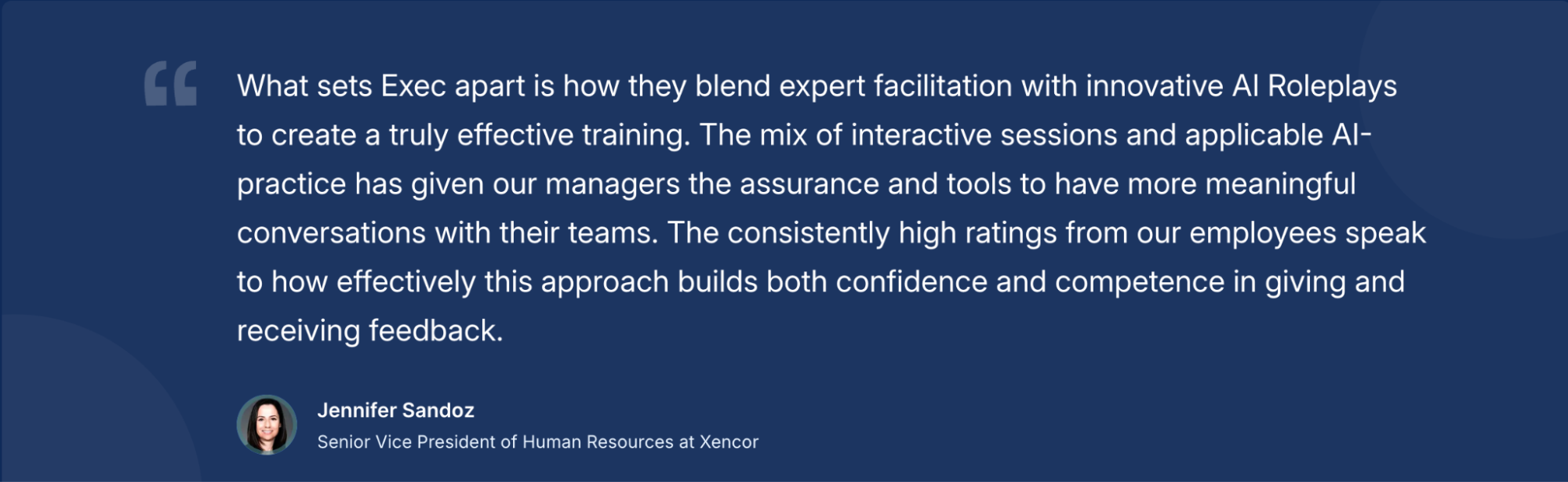
Presentation practice includes AI feedback on both conversation elements and visual communication, building confidence for complete customer interactions rather than separating talk tracks from demonstration reality.
Deployment Speed Matches Business Urgency
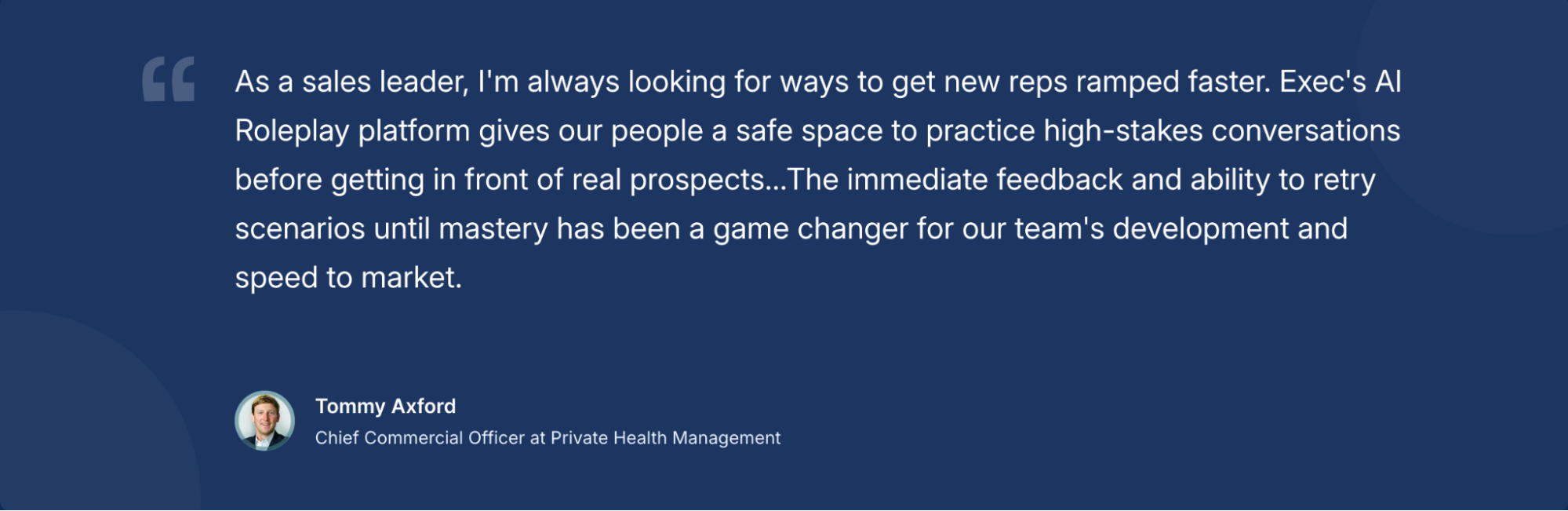
Custom scenarios deploy in approximately 90 seconds rather than weeks or months, matching product launch timelines and competitive threats that demand immediate conversation readiness.
Methodology Alignment Ensures Consistent Standards
A custom rubric evaluation connects practice directly to your organization's sales approach and certification requirements, rather than generic communication feedback that conflicts with manager coaching.
Exec Cons
Enterprise Focus Means Strategic Scope Decisions
Exec serves organizations needing conversation competency at scale across multiple teams and customer-facing roles. Companies requiring only 1-2 practice seats find a better fit with platforms designed for individual skill development.
Customization Capability Requires Implementation Investment
The platform excels at creating practice environments tailored to specific business contexts and sales methodologies. Organizations seeking fully preconfigured generic scenarios find that flexibility requires more setup effort.
Letter AI Review
Platform Overview
Enablement teams face content creation bottlenecks that delay program launches and prevent training materials from staying current as products evolve.
Building interactive training modules traditionally requires instructional designers, subject matter experts, and weeks of coordination between product marketing and enablement. Documentation exists across scattered systems but is never synthesized into cohesive training programs.
Letter AI applies generative AI to content production. The system analyzes existing company materials and generates complete training modules without manual instructional design.
Letter AI combines content management with training generation, coaching simulations, and digital sales rooms rather than forcing teams to coordinate across separate vendors for each function.
Platform Features
AI-Powered Training Creation
Letter AI's generative AI builds interactive training modules and certification pathways in minutes from your existing company materials, extracting relevant knowledge to generate complete training programs.
Content Management and Personalization
Content tools instantly create sales assets from scratch, personalizing them by vertical or customer using existing data. Content updates automatically as underlying documents change.
AI Coaching and Roleplay
Teams practice pitches with configurable mock personas and receive instant evaluations after each session. AI-generated insights analyze coaching conversations to reveal team strengths and skill gaps.
Letter AI Agent
Real-time assistance during sales conversations answers questions with responses grounded in your knowledge base. The agent declines to produce content when facts cannot be verified.
Digital Sales Rooms
Hyper-personalized AI sales rooms automate RFP processes and accelerate sales cycles, handling deal process busy work so sellers focus on relationship building.
Letter AI Pros
Content Generation from Existing Materials
Training creation accelerates through AI-generated courses built from existing documents in minutes rather than weeks.
Unified Platform Reduces Vendor Complexity
Content management, training, and coaching exist in a single environment rather than forcing coordination across separate vendors.
Company-Specific AI Training
AI trained on your organization's documents provides contextualized coaching rather than generic best practices.
Letter AI Cons
Limited Track Record for Enterprise Validation
Letter AI launched in 2023 with limited long-term customer case studies or public reviews compared to established enablement providers.
No Screen-Sharing Capability for Demo Practice
Letter AI lacks screen-sharing roleplay, where AI evaluates on-screen presentations during product demonstrations.
Content Creation Focus Over Practice Depth
Letter AI emphasizes the generation of training materials, prioritizing enablement productivity over conversation practice sophistication.
Broad Platform Scope May Reduce Specialist Depth
Attempting to address content management, training, coaching, and sales rooms creates potential tradeoffs where no single function achieves best-in-class depth.
Which Platform Should You Choose?
Letter AI serves teams where content creation speed represents the bottleneck. If your enablement team spends weeks building courses for each product launch, or competitive updates require constant material revisions, content generation from existing documents addresses that challenge.
Most revenue teams face a different problem. They have methodology training, competitive positioning documents, and product knowledge materials. Reps still freeze during objection handling. Demos vary wildly in quality. Discovery execution remains inconsistent despite framework certification.
That gap stems from execution under pressure, not content availability. Exec addresses this through voice-based practice where reps handle AI prospects who push back on pricing, question implementation timelines, or raise concerns mid-demo. Screen sharing during practice certifies complete selling motions, not just talk tracks.
The distinction matters because faster content creation doesn't build conversation competency. If your performance gap centers on reps knowing what to say but struggling to say it when deals depend on confident execution, practice under realistic pressure addresses that challenge.
Choose based on where deals actually break down. Content gaps or execution capability.
Build Conversation Competency That Transfers to Customer Pressure
Exec addresses the execution gap where reps know methodology frameworks but struggle during actual customer conversations.
If your team runs out of words during objection handling or delivers inconsistent demos despite training completion, then conversation practice under realistic pressure is what they need to build the skills that content consumption cannot.
Ready to see how your team practices high-stakes conversations in scenarios generated from actual sales content? Book a demo.