
Exec vs Outdoo AI: Conversation Practice vs Revenue Intelligence

Revenue operations teams face a fundamental choice: invest in conversation intelligence that analyzes what happened on sales calls, or build conversation competency that changes what happens next.
Call recording platforms show you where reps struggle. AI roleplay practice platforms prepare them to perform better. Some tools attempt both, creating integrated revenue intelligence with coaching features. Others focus exclusively on building skills through realistic practice environments.
Exec and Outdoo AI represent these different approaches. Outdoo AI delivers revenue intelligence with conversation analysis, CRM automation, and integrated coaching. Exec provides enterprise conversation practice through rapid custom-scenario deployment.
This comparison helps you choose between intelligence and competency development based on which drives greater value.
Exec vs Outdoo AI At A Glance
Understanding platform architecture matters before evaluating specific capabilities.
Brief Platform Overviews
Exec serves enterprise organizations needing rapid conversation competency development across multiple customer-facing functions.
The platform deploys custom practice scenarios in 90 seconds through agentic AI, enables voice-based roleplay with screen sharing for presentation practice, and coordinates training programs across sales, customer success, and management teams.
Outdoo AI targets revenue operations leaders with conversation intelligence that analyzes sales calls, scores rep performance, and provides AI coaching integrated with CRM data.
The platform records customer interactions, extracts deal insights, automates CRM updates, and offers roleplay practice built from actual conversation patterns.
Decision Criteria
Choose Exec when:
Skill gaps cause performance problems that visibility alone cannot address
Custom scenario deployment speed matches product launch and competitive response urgency
Screen-shared presentation practice matters for technical demonstrations and executive reviews
Conversation competency needs extend beyond sales to customer success and management teams
Building enterprise-wide conversation standards requires a coordinated training infrastructure
Choose Outdoo AI when:
Call recording and conversation analysis provide operational visibility you currently lack
CRM automation delivers immediate efficiency gains through reduced manual data entry
Deal intelligence and pipeline scoring improve forecasting accuracy and resource allocation
Sales-specific applications define your complete conversation training scope
Revenue operations infrastructure justifies investment beyond standalone practice capabilities
Exec vs Outdoo AI Feature Comparison
Feature | Exec | Outdoo AI |
G2 Score | 4.6/5 | |
Scenario Creation | ~90 seconds (agentic AI) | Template-based from call data |
Voice Practice | Full voice AI with interruptions | Voice-based buyer simulations |
Screen Sharing | Yes - demo practice with AI evaluation | No |
Conversation Intelligence | Practice-focused feedback | Real call recording and analysis |
CRM Integration | Standard | Deep Salesforce/HubSpot integration |
Deal Intelligence | No | Yes - pipeline health scoring |
Scenario Breadth | Sales + CS + management + compliance | Sales-focused |
Best For | Enterprise conversation competency | Revenue operations with sales coaching |
Starting Price | Custom enterprise quote | $9/user/month |
Exec: Best for Enterprise-Wide Conversation Competency
Platform Overview
Exec is the Agentic Learning Platform, built for organizations that need conversation training across multiple customer-facing functions and leadership roles. Agents produce the training from your own material, conduct it, and evaluate the people doing it across AI roleplay, courses, knowledge management, call scoring, programs, and coaching.
Rather than optimizing single use cases like call analysis or prospecting practice, Exec addresses competency development from initial discovery calls through complex negotiations, customer renewals, and difficult management conversations.
The platform solves deployment speed through agentic scenario creation that generates custom practice environments from simple prompts in approximately 90 seconds.
Organizations facing urgent competitive threats or product launches create tailored scenarios immediately rather than waiting months for traditional content development cycles.
The core differentiator: integrated screen sharing during voice-based roleplays where AI evaluates both conversation quality and presentation effectiveness simultaneously, preparing teams for the complete customer interaction rather than separating talk tracks from visual demonstrations.
Platform Features
Agentic Scenario Creation
Agentic scenario creation transforms text or voice descriptions into fully functional roleplay environments in roughly 90 seconds by incorporating competitive intelligence, customer objections, and organizational methodology into AI-generated practice scenarios.
Sales enablement leaders face impossible timelines when competitors announce pricing changes or product features that demand immediate team preparation. Traditional scenario development requires weeks of writing, recording, and testing, while deals are already in motion.
A customer success director types: "Create a renewal conversation where the customer experienced a service outage during their peak season, usage dropped 40%, and they're evaluating cheaper alternatives with better uptime guarantees."
The system generates the scenario instantly. A CSM starts practicing. The AI customer opens aggressively.
AI Customer: "Let's talk about renewal. Your platform went down for six hours during our Black Friday weekend. We lost revenue, and frankly, I'm questioning whether this partnership makes sense anymore."
CSM: "I completely understand your frustration about the outage. That's unacceptable, and we take full responsibility."
AI Customer: "Taking responsibility is fine, but I need to know what changed. Your competitor hasn't had downtime issues, and they're offering similar features at 25% less."
The CSM struggles through the conversation, focusing on apologies without addressing the systemic improvements or competitive differentiation. The session ends.
AI feedback appears: "You acknowledged the problem effectively, but didn't pivot to what we've changed in infrastructure or address the competitive pricing concern with value differentiation. The customer needed confidence in our reliability improvements before discussing contract terms."
Three practice sessions later, the CSM confidently handles outage discussions by leading with infrastructure investments, demonstrating improved monitoring capabilities, and reframing pricing around total cost of ownership rather than sticker price comparison.
Unlimited Voice-Based AI Roleplay Practice
On-demand voice conversations with AI characters that interrupt, push back, and respond unpredictably create the interaction pressure necessary for skill retention rather than scripted exchanges that build false confidence through predictable patterns.
Reps schedule practice whenever performance gaps appear instead of waiting for manager availability or peer roleplay coordination. This shift transforms conversation training from quarterly events requiring calendar coordination into daily skill-building that develops muscle memory through consistent repetition under realistic pressure.
Screen Sharing During Roleplays
Reps present slide decks and demonstrate software during voice conversations while AI simultaneously evaluates presentation flow, visual clarity, and how effectively they handle questions that interrupt planned sequences, providing feedback on both verbal responses and on-screen navigation.
Complex enterprise sales depend on presentation execution as much as conversation skills. Practicing talk tracks separately from actual product demonstrations creates artificial training environments that fail to replicate customer meetings where technical questions interrupt slides and stakeholder concerns require real-time visual clarification.
An enterprise software rep practices their quarterly business review presentation with their largest customer's CFO. They share their screen, open their QBR deck, and begin walking through usage metrics. Four slides into performance data, the AI CFO interrupts sharply.
AI CFO: "Hold on. Go back to that utilization chart. Why are we only at 60% adoption across departments when we're paying for 200 licenses?"
The rep navigates back quickly, highlights the adoption breakdown, and addresses the concern by showing quarter-over-quarter improvement trends while acknowledging the gap.
The session concludes with feedback addressing both elements: "Strong recovery on the adoption question by showing improvement trends.
However, you should bookmark key slides before presenting to CFOs who typically focus on cost efficiency metrics. Consider adding department-specific adoption plans to your standard QBR deck."
Custom Rubrics & Performance Scoring
Organizations define evaluation criteria by uploading sales methodologies (MEDDIC, SPIN, Sandler, proprietary frameworks) and AI scores every practice session against those specific standards rather than generic communication principles, ensuring feedback aligns with how your organization actually defines conversation excellence.
Generic improvement feedback disconnected from organizational standards creates confusion and undermines manager coaching when AI suggestions contradict methodology priorities.
A financial services company requires compliance-ready conversations following specific disclosure patterns and risk acknowledgment language. Reps practice investment discussions.
AI scores against their actual compliance rubric: "You covered three of five required disclosure statements during the risk discussion. You acknowledged the client's understanding effectively, but missed documenting their income verification timeline. Your product recommendation followed suitability assessment protocols correctly."
Programs, Cohorts, and Certification
Programs coordinate learning paths across distributed teams through assignment management, deadline enforcement, certification tracking, and analytics that show practice engagement, performance trends by region and role, common struggle patterns across scenarios, and the correlation between practice volume and business outcomes like win rates or customer satisfaction scores.
Exec Pros
Rapid Custom Deployment Matches Business Urgency
Scenario creation in minutes instead of traditional multi-month development cycles means teams practice competitive objections the day threats emerge, prepare for product launches when business demands readiness, and address emerging customer concerns before they impact revenue at scale.
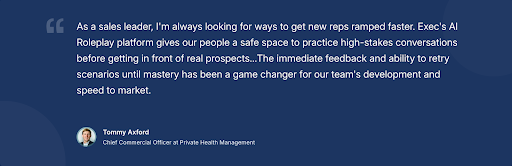
Voice-Based Realism Creates Transferable Skills
Stress-response learning through pressure that replicates actual customer interactions builds conversation competency that survives real objections and unexpected questions, contrasting with knowledge acquisition through passive content consumption that evaporates when prospects challenge assumptions or stakeholders push back during negotiations.
Enterprise Breadth Beyond Sales-Only Focus
Manager coaching conversations, customer success renewal discussions, technical support de-escalation scenarios, and cross-functional stakeholder management all receive identical practice infrastructure that sales-focused platforms reserve exclusively for revenue team applications, enabling organizational conversation standards across all customer-facing functions.
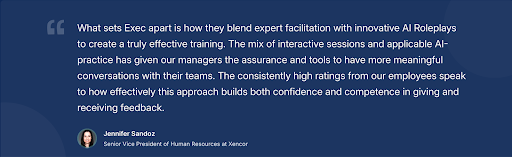
Screen Sharing Enables Complete Demo Readiness
Presentation practice includes AI evaluation of both verbal communication and visual effectiveness during product demonstrations, building confidence for the integrated customer experience, where conversation quality and presentation execution both determine outcomes, rather than treating talk tracks and demos as separate training domains.
Exec Cons
Enterprise Focus Limits Small Team Fit
Exec serves organizations needing conversation competency at scale across multiple teams and use cases. Small businesses requiring 3-5 practice seats find better value in entry-level platforms designed for individual skill development rather than organizational transformation and cross-functional coordination infrastructure.
Customization Investment Required Upfront
The platform excels at creating bespoke practice environments tailored to specific business contexts, competitive situations, and organizational methodologies. Teams seeking completely pre-configured, generic scenarios without any customization effort find that flexibility demands more initial setup investment than plug-and-play alternatives.
Outdoo AI
Platform Overview
Outdoo AI is a revenue intelligence platform for sales operations teams that combines conversation insights from customer calls with coaching capabilities. The platform records sales interactions, analyzes conversation patterns, scores rep performance, and updates CRM records while providing AI roleplay practice based on conversation data.
Originally launched as MeetRecord in 2022, the platform rebranded to Outdoo AI in 2024, expanding from call recording into comprehensive revenue intelligence. CRM integration pulls sales data into practice scenarios while conversation analysis identifies coaching opportunities.
Platform Features
AI Conversation Intelligence
Records and transcribes sales calls with speaker identification, conversation analysis using generative AI, and real-time context extraction that identifies buyer signals, sentiment patterns, and deal risk indicators from actual customer interactions.
Automated Call Scoring
AI-powered performance evaluation against key behaviors like discovery depth, objection handling, and closing effectiveness, removing subjective bias from manager assessments while connecting coaching insights to revenue outcomes and performance gaps.
AI Sales Roleplays
Practice scenarios built from CRM data and actual buyer patterns where AI simulates realistic objections, decision-making processes, and personality types encountered in real deals, with feedback on tone, objection responses, and conversation structure.
Deal Intelligence Dashboard
Calculated health scores using 75+ parameters from CRM, email, and call data to identify stalled opportunities early, track deal activity timelines, analyze buyer sentiment shifts, and provide pipeline visibility for revenue forecasting.
CRM Automation
Deep Salesforce and HubSpot integration that automatically populates CRM fields from conversation details, captures call recordings and transcripts directly in deal records, and extracts buyer signals without manual data entry requirements.
Outdoo AI Pros
Revenue Intelligence Beyond Practice
Conversation recording and analysis provide insights from actual customer interactions that inform coaching priorities, identify best practices from top performers, and reveal deal risks before opportunities stall. Organizations already using call recording platforms may find overlapping functionality with existing tools.
CRM Integration Reduces Manual Work
Automated data capture from sales calls eliminates the administrative burden of updating opportunity records, logging next steps, and documenting buyer concerns. Implementation requires coordination with existing CRM workflows and data governance policies to avoid duplication or conflicting information sources.
Call-Based Coaching at Scale
AI scoring of actual customer conversations identifies specific performance gaps across teams without requiring managers to review every call manually. The effectiveness depends on the quality of scoring criteria and how well automated feedback aligns with organizational coaching standards and methodology priorities.
Accessible Entry Pricing
Starting at $9 per user per month makes the platform accessible to small- and mid-market sales teams that need conversation intelligence and coaching without enterprise-level budget commitments. Pricing scales with features, and organizations should evaluate whether higher-tier capabilities justify increased per-seat costs for their specific use cases.
Outdoo AI Cons
Sales-Specific Limitation
Platform optimization focuses exclusively on revenue team applications without extending to customer success, management coaching, or cross-functional training needs that require conversation competency beyond sales interactions.
Recording-Dependent Value
Core features require call recording infrastructure and customer consent protocols that some industries or regions restrict, limiting applicability for organizations with regulatory constraints or customer privacy sensitivities around recorded conversations.
Practice Scenarios Lack Customization Depth
Roleplay capabilities rely on CRM data and conversation patterns rather than rapid custom scenario creation for specific competitive situations, product launches, or emerging objections that demand immediate practice deployment outside standard sales cycle patterns.
Which Platform Should You Choose?
Outdoo AI serves teams needing operational visibility. Recording infrastructure captures execution patterns and reveals methodology adherence through conversation analysis. This works when you have competency but lack visibility into consistency and deal health.
Exec is better than Outdoo AI because it solves the root cause—skill gaps—rather than just surfacing symptoms. Analysis shows what went wrong after deals are lost. Practice prevents those losses before reps face customers. Outdoo AI provides retroactive data. Exec provides proactive skill development through realistic AI roleplay that builds confidence and muscle memory under pressure.
Scale Conversation Competency Across Your Organization
Exec delivers enterprise-wide conversation competency through AI roleplay that builds skills before customer interactions, not after deals are lost.
Custom scenarios deploy in 90 seconds. Screen sharing during voice-based practice ensures reps master both conversation and presentation execution. The platform spans sales, customer success, and management—all under one infrastructure with consistent evaluation standards.
Unlike conversation intelligence that shows what went wrong, Exec prevents those problems by building muscle memory and confidence under realistic pressure.
Ready to see how Exec builds conversation competency that survives customer pressure across your entire organization? Book a demo.