
Exec vs Uplimit: Practice Deployment vs. Course Development Speed

Your competitor just announced a feature that threatens your differentiation. You need the team to practice new positioning by Friday. Every platform promises "fast deployment," but fast means different things.
Uplimit builds structured courses using AI. Generate modules, organize cohorts, and track completion. Good for systematic upskilling when you have weeks to roll out programs.
Exec deploys practice scenarios in 90 seconds. Create the objection-handling drill, and have reps start practicing immediately.
Course development speed or practice deployment speed. When markets move faster than training calendars, the distinction matters. This comparison shows what each platform actually delivers and where timing creates capability gaps.
Exec vs Uplimit At A Glance
Exec is the Agentic Learning Platform, serving enterprise organizations that need conversational competency across revenue teams. Agents generate tailored roleplay scenarios in approximately 90 seconds and evaluate the people running them. Teams practice high-stakes conversations through voice-based AI that responds unpredictably, alongside courses, sales content management, call scoring, programs, and coaching.
Uplimit targets organizations scaling technical upskilling and compliance training across large workforces. The platform uses generative AI to create courses from existing documents in hours rather than weeks. Cohort management tools, automated learner support through AI agents, and progress tracking handle the administrative burden of running programs across thousands of employees.
Decision Criteria
Choose Exec if:
Conversation execution under pressure determines deal outcomes
Product launches demand immediate practice readiness, not quarterly course rollouts
Screen-shared demo practice matters for complex B2B presentation effectiveness
Custom scenario creation in 90 seconds addresses urgent competitive threats
Choose Uplimit if:
Systematic upskilling across technical skills or compliance requires structured course delivery
Course creation speed from existing materials reduces the enablement workload
Cohort management and automated learner support scale training administration
Blended learning programs combining self-paced and live sessions match your approach
Exec vs Uplimit Feature Comparison
Feature | Exec | Uplimit |
G2 Score | ||
Primary Focus | Conversation practice deployment | AI-powered course creation |
Scenario Creation | ~90 seconds (agentic AI) | 3-5 hours for complete courses |
Voice Practice | Voice-based AI Roleplay with unpredictable responses | AI roleplay modules within courses |
Screen Sharing | Full demo simulation with AI evaluation | No |
Deployment Speed | Immediate (90 seconds per scenario) | Hours for courses, instant for learner nudges |
Best For | Urgent conversation readiness across sales, CS, and management | Systematic upskilling for technical and compliance training |
Starting Price | Custom enterprise quote | Custom enterprise quote |
Exec: Best for Conversation Competency When Timing Matters
Platform Overview
Sales enablement leaders face teams that understand frameworks but freeze during actual customer pressure. Discovery methodology makes sense in training documents. Objection handling looks straightforward in playbooks. Then prospects deviate from expected patterns or negotiations take unexpected turns, and performance gaps become visible.
Exec builds conversation competency through realistic practice under conditions that mirror actual customer interactions. Voice-based AI responds unpredictably like real buyers. Reps practice scenarios where customers withhold information, challenge assumptions, or raise objections that weren't covered in methodology training.
When a competitor announces pricing changes or launches a feature that threatens your differentiation, teams need to practice new positioning immediately. Traditional training development takes weeks to build courses and coordinate rollouts. Exec creates practice scenarios in 90 seconds, eliminating the gap between recognizing the threat and preparing your team to respond.
Platform Features
Agentic Scenario Creation
Agentic AI builds fully customized practice environments in approximately 90 seconds from simple text or voice prompts. A sales enablement director describes the challenge: "Create a renewal conversation where the customer received a competitive offer at 25% lower pricing and questions whether our premium features justify the cost difference."
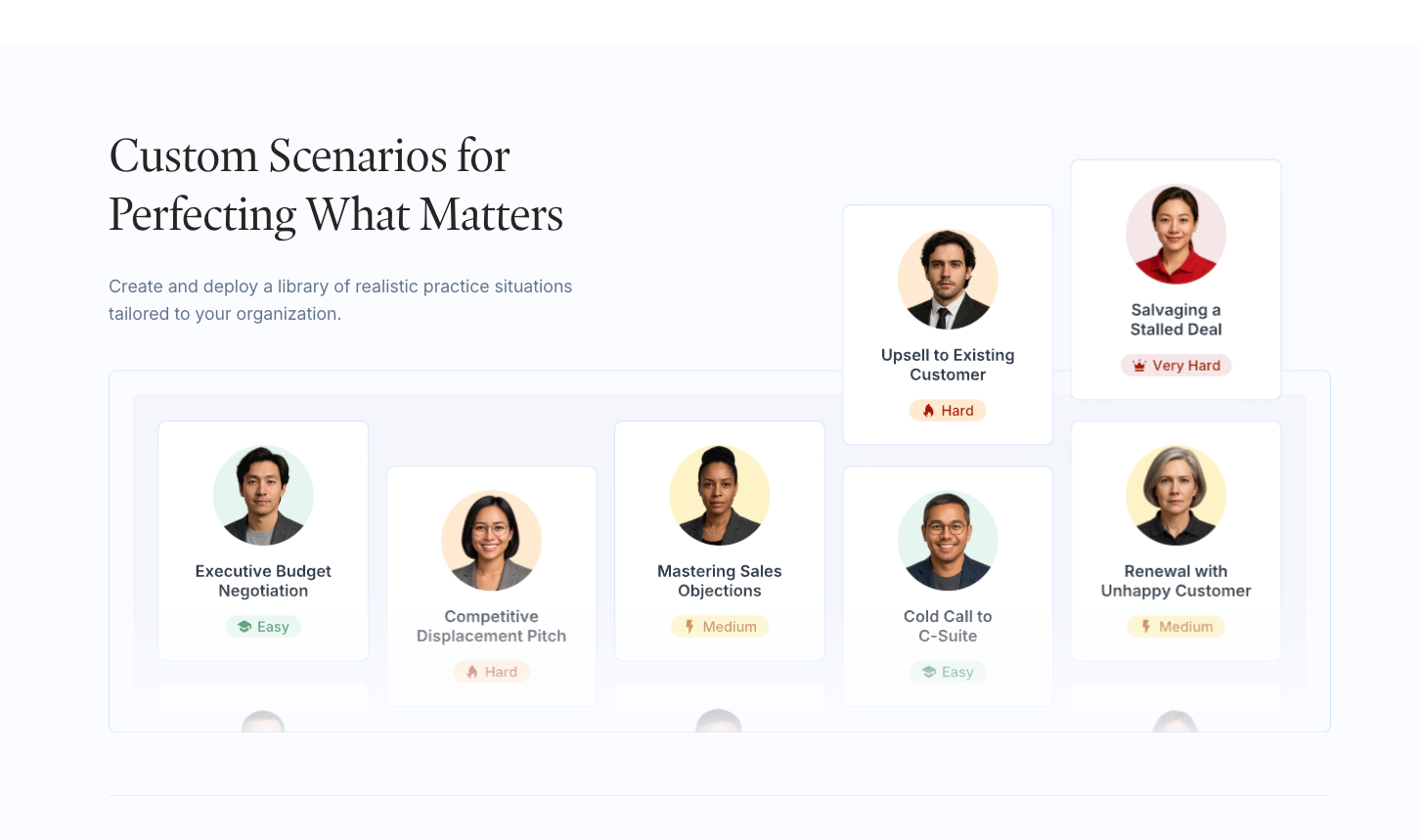
The scenario deploys immediately. The customer success manager enters the practice session.
AI Customer: "I'll be direct. We've been comparing renewal options, and your competitor came in significantly lower. What exactly am I paying extra for here?"
CSM: "I appreciate you being upfront. Can you walk me through which features matter most for your team's workflow?"
AI Customer: "We need the standard reporting and integrations. Their platform does that. Your advanced analytics sound nice, but I'm not sure they're worth the premium."
The conversation continues for six minutes. The CSM explains feature differences but struggles when asked about implementation complexity and total cost of ownership, which factor into true pricing comparison.
AI feedback appears: "You asked appropriate discovery questions about feature priorities. However, you didn't explore their experience with basic reporting, which limited them as their data needs grew. You also missed quantifying how long competitor implementations typically take, which could have justified premium through faster time-to-value and lower internal resource costs."
The CSM practices four more times, each iteration improving their ability to connect premium pricing to business outcomes the customer actually cares about.
Screen-Shared Demo Practice
Complex B2B sales depend on the quality of presentations. A prospect who asks "Show me how your analytics dashboard handles real-time alerts" needs to see actual screens, not hear descriptions. Reps share screens during voice practice, demonstrating products while AI evaluates both verbal effectiveness and on-screen presentation quality.

Sales engineers conduct software demonstrations where AI assesses navigation speed, whether explanations match what's visible, and how they recover when stakeholders interrupt slide three with integration questions that require jumping to a different section entirely.
Voice-Based Stress-Response Learning
Voice-based AI creates the pressure necessary for genuine skill retention. The AI doesn't follow scripts. Prospects raise objections you didn't train for. Customers push back in ways that challenge prepared responses. This unpredictability replicates real conversations where customers never follow your ideal talk track.
Custom Rubric Alignment
Organizations upload their specific sales methodologies, such as MEDDIC, SPIN, Challenger, or proprietary frameworks. AI scores every practice session against those exact standards. A financial services company uploads its compliance-first discovery approach.
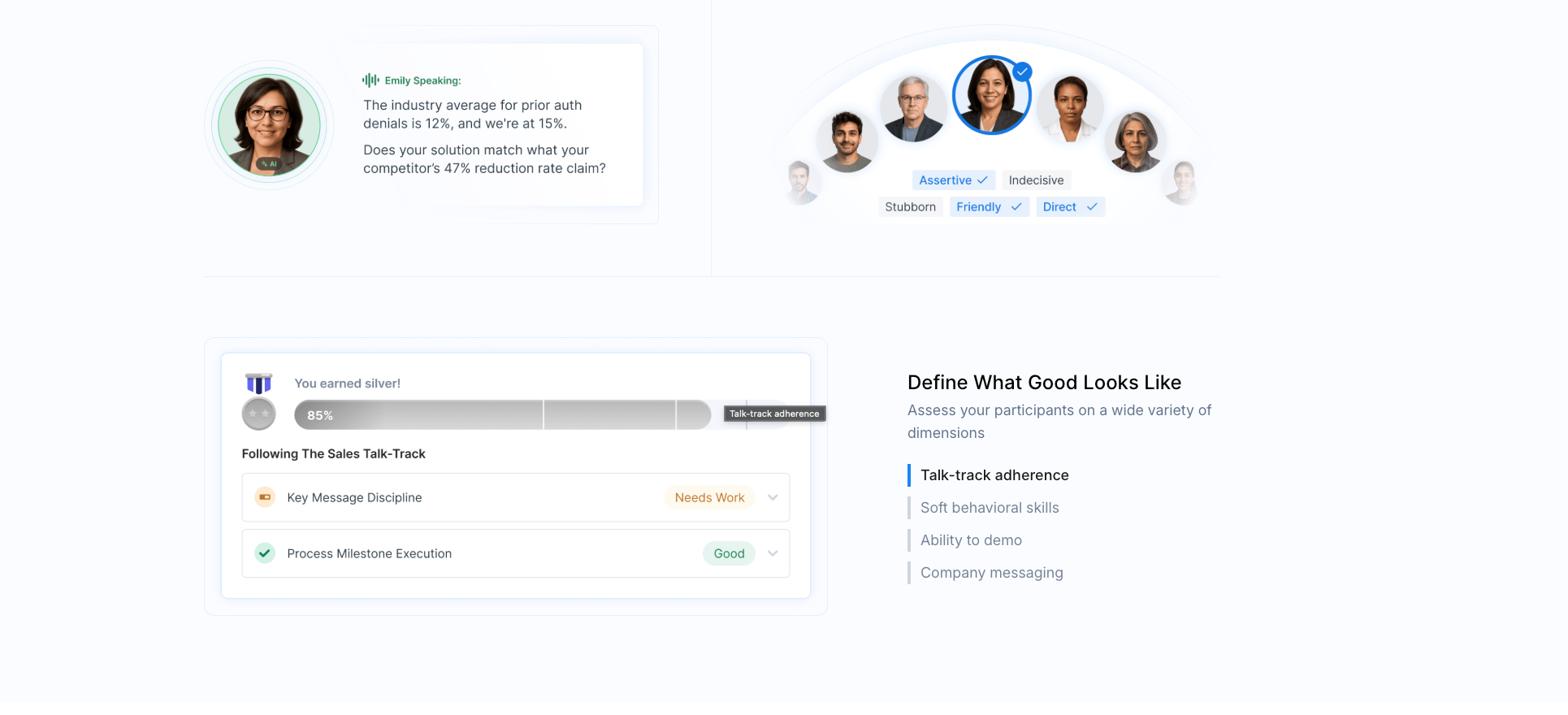
Reps practice discovery calls. AI scores against their organizational standards: "You established rapport effectively and asked about current processes. You missed exploring regulatory compliance history and didn't uncover risk tolerance levels before discussing solutions. Your discovery covered 4 of 7 framework components according to your organization's certification requirements."
Enterprise-Wide Scope
Sales prospecting is just one of the conversation types organizations need to master. Managers struggle with performance discussions where they need to deliver difficult feedback. Customer success teams avoid renewal conversations when customers push back on pricing.
Account executives fumble when multiple stakeholders in a buying committee ask conflicting questions. Exec addresses competency across these contexts through unified infrastructure rather than forcing separate point solutions for each function.
Exec Pros
Deployment Speed Matches Business Urgency
Custom scenarios deploy in approximately 90 seconds, not the weeks required for traditional course development. When competitors launch new features or announce pricing that threatens your deals, teams practice responses immediately. Your reps start rehearsing before customer calls happen, not after deals are already lost.
Realistic Practice Transfers to Customer Pressure
Voice-based stress-response learning builds conversation competency that withstands actual customer interactions. AI responds unpredictably, creating the pressure needed to retain skill rather than knowledge that disappears during the first real objection.
Screen Sharing Enables Complete Demo Certification
Presentation practice includes AI feedback on both conversation elements and visual effectiveness. Reps build confidence for complete customer interactions rather than separating talk tracks from demonstration reality that defines complex sales.
Methodology Alignment Ensures Consistent Standards
Custom rubric evaluation connects practice to your organization's specific approach. Reps receive feedback that aligns with manager coaching rather than generic communication suggestions that create confusion about certification requirements.
Exec Cons
Enterprise Focus Requires Strategic Scope Decisions
Exec serves organizations needing conversation competency at scale across multiple teams and customer-facing roles. Companies requiring only basic practice for 1-2 individuals find a better fit with entry-level platforms designed for individual skill development.
Customization Capability Requires Implementation Investment
The platform excels at creating practice environments tailored to specific business contexts and methodologies. Organizations seeking fully preconfigured generic scenarios find that the flexibility required exceeds the setup effort of off-the-shelf alternatives.
Uplimit Review
Platform Overview
Uplimit applies generative AI to course production. The platform analyzes existing materials and generates complete training modules without manual instructional design.
Courses covering technical skills, compliance requirements, and leadership development can be deployed in hours rather than the weeks traditional development requires.
The platform combines course creation, cohort management, and automated learner support. AI agents answer learner questions 24/7. Progress tracking and automated nudges keep learners engaged.
Analytics show completion rates and connect training to outcomes, such as whether engineers who completed security training reduced incidents or whether sales reps who finished product training increased deal sizes.
Platform Features
AI-Powered Course Creation
Generative AI builds complete courses from existing company documents in 3-5 hours. Upload product documentation, process guides, or training materials. The AI identifies key concepts, generates learning objectives, creates assessments, and structures everything into modules with interactive elements.
Cohort Management and Automated Support
Organize learners into cohorts, track progress, and send automated reminders without managing spreadsheets. AI learning agents answer common questions 24/7 ("Where do I find the API documentation?" or "What's the deadline for module three?"), removing the burden from trainers and managers who otherwise field dozens of repetitive questions.
Blended Learning Programs
Combine self-paced modules with live sessions and discussion forums. Video lessons, interactive quizzes, peer discussions, and live instructor-led workshops are all within the same program, rather than forcing learners to switch between separate tools.
AI Roleplay Modules
Some courses include AI-driven roleplay practice for specific topics. Teams practice customer conversations or pitch delivery with instant feedback. These modules sit within broader courses rather than operating as standalone practice environments.
Analytics and Reporting
Track who's completing modules, who's falling behind, and where learners struggle most. Dashboards show engagement patterns by department, assessment scores by cohort, and time-to-completion across programs. Analytics connect training participation to business outcomes ("Did engineering teams who completed security training reduce incidents?") and flag learners who need intervention before they disengage completely.
Uplimit Pros
Course Creation Speed Reduces Development Bottlenecks
Generating training modules from existing documents in hours addresses the timeline challenge of traditional instructional design. Enablement teams deploy new programs faster when products evolve or compliance requirements change.
Cohort Management Scales Administrative Complexity
Automated learner support, progress tracking, and engagement nudges handle the administrative burden of enterprise-wide programs. Learning leaders manage hundreds or thousands of learners without proportional increases in staff.
Unified Platform Reduces Tool Fragmentation
Course creation, cohort management, learner support, and analytics exist in a single environment. Organizations eliminate the complexity of coordinating separate vendors for different training functions.
Uplimit Cons
Course Model Creates Deployment Delays for Urgent Needs
Even with a 3-5 hour course creation time, structured programs can't address sudden competitive threats or market changes that demand immediate practice-readiness. The course development model introduces an inherent delay between recognizing a need and teams being able to practice responses.
Limited Conversation Practice Depth
AI roleplay exists as modules within broader courses rather than as a core capability. Organizations requiring sophisticated conversation practice find the integrated approach less robust than specialized platforms built primarily for roleplay.
No Screen Sharing for Demo Practice
The platform lacks screen-sharing, so learners can practice presentations or product demonstrations while AI evaluates on-screen actions. Complex B2B sales requiring demo certification need this capability.
Structured Programs Struggle with Business Velocity
Systematic upskilling works when you build foundational skills over quarters. The approach falters when competitive positioning changes overnight, and teams need practice before customer calls determine outcomes.
Which Platform Should You Choose?
Uplimit serves organizations where course creation represents the bottleneck. If your L&D team coordinates subject matter experts for weeks to build technical training, course generation from existing documents addresses that challenge.
Most revenue enablement teams already have the content. Sales methodology documentation exists. Competitive positioning guides outline responses. Objection-handling frameworks reside in shared drives. The performance gap shows up elsewhere.
Reps lose deals when prospects push back on pricing. Demos collapse when buyers ask unexpected questions. Discovery calls miss qualification criteria that could have flagged dead-end opportunities weeks earlier. These failures don't trace back to missing training materials.
Course creation speed addresses content bottlenecks. It doesn't address what happens when a CFO dismisses your ROI calculation mid-presentation, when a competitor drops pricing, and teams face customer calls the next morning, when prospects deviate from expected patterns, and reps freeze because they've never practiced handling that specific pushback under pressure.
The distinction matters because completing training content and executing conversations under customer pressure require different solutions. One produces more materials. The other builds capability that transfers to actual deal situations.
Choose based on where your deals actually break down.
Build Conversation Competency at Market Speed
Structured programs work when you're building foundational skills across quarters. They fail when competitive threats emerge overnight, demanding immediate readiness.
Exec creates scenarios in 90 seconds. Screen sharing practices complete demos, not just course content. Custom rubrics align to your current competitive situation and sales approach, not outdated training materials that don't reflect today's market.
Course completion or conversation readiness. One tracks learning progress. The other prepares teams before customer calls and determines outcomes.
Ready to see how realistic practice under pressure prepares your team? Book a demo.