
Bigtincan vs Hyperbound: Which Sales Enablement Platform Fits Your Revenue Strategy?

Bigtincan and Hyperbound both aim to make revenue teams more effective, but they tackle very different parts of the problem.
Bigtincan consolidates content, training, and buyer engagement into a single enablement platform so sellers can find, learn, and share the right material across the buyer journey.
Hyperbound, by contrast, narrows in on SDR and AE call practice, using AI buyers, dialer-style simulations, and call scoring to sharpen outbound prospecting skills.
For a sales enablement leader, the real question is whether your immediate constraint is enablement infrastructure or cold-call performance.
This comparison explores which platform better fits your revenue strategy: content governance or conversation rehearsal.
Platform Comparison At A Glance
Bigtincan is a comprehensive revenue effectiveness platform consolidating content management and sales readiness into a unified infrastructure. The platform targets enterprise organizations where scattered content repositories and disconnected enablement tools create inefficiencies across customer-facing teams.
Hyperbound is an AI sales coaching platform specializing in voice-based roleplay practice across the entire sales cycle. AI trained on extensive B2B sales conversation data simulates realistic buyer interactions from cold calls through post-sales conversations, providing automated feedback without requiring manager involvement.
Decision Criteria
Choose Bigtincan if:
Your organization needs a revenue enablement infrastructure integrating content management, AI-powered coaching, and training capabilities
Your primary challenge involves content chaos across teams, requiring centralized organization with mobile-first delivery
Your sales process requires AI-driven intelligent search and contextual recommendations during customer meetings
Your implementation timeline accommodatesa 3-month deployment for enterprise complexity
Choose Hyperbound if:
Your SDR teams need intensive conversation practice without broader platform infrastructure
Your training deployment requires completion within 1-2 weeks for immediate practice needs
Your technology approach integrates conversation practice with existing sales tools rather than replacing them
Your sales methodology requires custom AI scorecards aligned with specific frameworks
Choose Exec if:
Your sales organization needs both AI roleplay practice and conversation intelligence in a unified platform
Your coaching workflow requires a seamless connection between practice sessions and actual customer call analysis
Your enablement strategy prioritizes real-time in-call guidance alongside post-call coaching
Your implementation approach values pre-configured best practices with rapid deployment
Bigtincan vs Hyperbound vs Exec Feature Comparison
Dimension | Exec | Bigtincan | Hyperbound |
G2 Score | |||
Core focus | Enterprise conversation practice across sales, CS, and leadership. | AI-powered revenue enablement platform for content, readiness, and buyer engagement. | AI roleplay and coaching for SDR/AE cold calling and outbound. |
Primary users | Sales reps, SEs, CSMs, managers, and leaders. | Sales, marketing, customer success, and channel teams needing centralized enablement. | SDRs and AEs practicing prospecting calls; their managers. |
Scenario creation speed | Agentic AI; custom scenarios from prompts in ~90 seconds. | Scenarios embedded in courses and programs; rollout tied to multi-month implementations. | Bot builder from ICPs and call data; scenarios configured in minutes but dependent on setup. |
Screen-share practice | Yes; AI evaluates talk track plus on-screen navigation for demos. | Digital sales rooms and presentations; no deep AI scoring of live demo navigation. | Voice-first cold-call simulations; no primary focus on demo screen-sharing. |
Type of feedback | Rubric-based scoring tied to sales and leadership methodologies. | Content, readiness, and engagement analytics across assets and programs. | Call scores, AI buyer feedback, and performance metrics for prospecting skills. |
Practice vs infrastructure | Proactive practice layer on top of existing tools. | Core infrastructure for content, training, and buyer engagement. | Practice and coaching focused on outbound calls; relies on existing CRM/enablement stack. |
Revenue lifecycle fit | Discovery, demos, negotiations, renewals, escalations, and manager conversations. | Broad buyer journey support via content and readiness; less focused on live-practice depth. | Early-funnel prospecting and qualification conversations. |
Bigtincan Review
Bigtincan is a Revenue Enablement Platform designed for B2B sales organizations, marketing teams, and field service personnel facing content fragmentation. Sales enablement leaders who manage distributed content libraries are the primary buyers.
The platform solves this problem through AI-powered content management that delivers contextually relevant materials via mobile-first interfaces optimized for field usage. SearchAI enables intelligent discovery across content libraries, automatically suggesting materials based on deal context.
The platform connects with CRM and content systems through integrations. Implementation typically takes 3 months, with options for self-configuration or assistance from the Customer Success team.
Key Features
AI-Powered Content Management
SearchAI delivers intelligent content discovery that suggests relevant materials based on deal context and customer profiles, with automatic version control and governance. The platform connects with enterprise content systems, including Adobe AEM and Microsoft SharePoint, with automatic syncing.
Sales Readiness and Training
The platform delivers mobile-first training modules with adaptive microlearning paths tailored to individual skill gaps. Self-guided courses enable representatives to progress at their own pace, with quiz-based reinforcement validating knowledge retention. The system tracks completion rates and quiz performance to identify knowledge gaps requiring additional reinforcement.
RolePlayAI Conversation Practice
RolePlayAI creates AI sales simulations that generate text and audio conversations with AI counterparts. The system records conversations and analyzes vocal delivery, including speaker duration, volume, tone, and keyword usage.
Coaching and Performance Management
The platform provides coaching workflows, including on-demand assignments, video coaching with conversation intelligence, and Sales Rep Scorecards. Managers assign coaching exercises for representatives to complete independently, review submission recordings, and provide feedback.
Pros
Unified content hub reduces time spent searching for sales materials across disconnected repositories
Mobile-first delivery enables field representatives to access training and content without desktop dependencies
Enterprise governance controls ensure content compliance and version management across distributed teams
Cons
The platform lacks certain features available in competing sales enablement solutions
A 3-month implementation timeline may create delays for teams requiring rapid deployment
The internal setup process requires configuration time for customization
Hyperbound Review
Hyperbound is an AI-powered sales role-play platform serving B2B sales development representatives and outbound teams that require intensive conversation practice. The platform solves this problem by using voice-based AI to create interactive buyer personas that simulate realistic conversations.
Users generate custom AI personas by describing their ICP, scenarios, and desired characteristics. Custom AI scorecards align with organizational sales methodologies and messaging frameworks, analyzing performance against company-specific criteria.
For sales enablement leaders, Hyperbound functions as a specialized practice layer within broader training technology stacks.
Key Features
Voice-Based AI Roleplay System
The platform creates interactive buyer personas simulating realistic sales conversations, including cold calls, discovery calls, demos, negotiations, and renewals. The system converts ICP descriptions into interactive AI buyers in under two minutes through a no-code builder.
Custom Scorecards and Rapid Scenario Building
Organizations customize AI scorecards for specific sales methodologies or messaging frameworks, add industry-specific objections, and create scenarios matching their ICP. Building the first bot and scorecard takes under 10 minutes from initial setup.
Real Call Integration and Analysis
The platform imports calls from existing conversation intelligence systems, including Gong and Chorus, providing detailed coaching feedback beyond basic keyword detection. Custom AI scorecards analyze calls against organizational methodology rather than generic best practices.
Pros
Voice-based roleplay scenarios simulate realistic buyer behavior, improving skill transfer to actual customer calls
Scenario customization in under 10 minutes enables rapid response when competitive situations or messaging priorities shift
Rapid deployment within 1-2 weeks matches business urgency for immediate practice needs
Conversation intelligence integration targets practice scenarios to actual skill gaps identified in real customer calls
Cons
Contact-based or quote-based pricing models can lack transparency, but in the sales enablement and AI roleplay space, many competitor platforms also do not publish standard rates publicly
Specialized focus on SDR roles may require supplementary solutions for other revenue team positions
Scenario customization requires an initial time investment to build libraries
How Exec Delivers What Bigtincan and Hyperbound Cannot
Exec sits between a heavy infrastructure platform and a narrow call simulator: it is designed as a practice-first layer that turns your real talk tracks, product demos, and objections into fast, AI-driven simulations across the revenue org. The emphasis is on getting people conversation-ready this week, not just more organized or more active on calls.
90-Second Agentic Scenario Creation
Exec generates tailored roleplay scenarios from a short prompt in about 90 seconds, so teams can practice new pricing, messaging, or competitor stories the same day those changes land.

Bigtincan scenarios typically sit within courses and broader programs that require weeks of design and rollout, and Hyperbound's bot builder depends on ICP configuration and call data, which slows response time when you need immediate field practice.
Screen Sharing for Demos, Not Just Calls
Exec supports voice plus screen sharing, letting reps run live demos, navigate products, and flip through decks while the AI buyer reacts and the system scores both conversation flow and on-screen behavior.

Bigtincan focuses on content, readiness, and digital sales rooms rather than AI-evaluated demo practice, and Hyperbound is explicitly voice-first for cold calls without deep screen-aware simulation.
Voice-Based Stress-Response Learning
Exec emphasizes pressure-realistic practice: AI buyers interrupt, push back on ROI, and change direction mid-call, forcing real-time decisions that mirror tough customer conversations. Bigtincan's strengths are structured learning and content-driven readiness, not stress-response simulation, while Hyperbound's scenarios are optimized around high-volume prospecting flows rather than the full range of late-stage or executive conversations.
Revenue-Wide Scope and Custom Rubrics
Exec supports discovery, demos, negotiations, renewals, escalations, and manager performance conversations across sales, customer success, and leadership teams within a single practice environment.
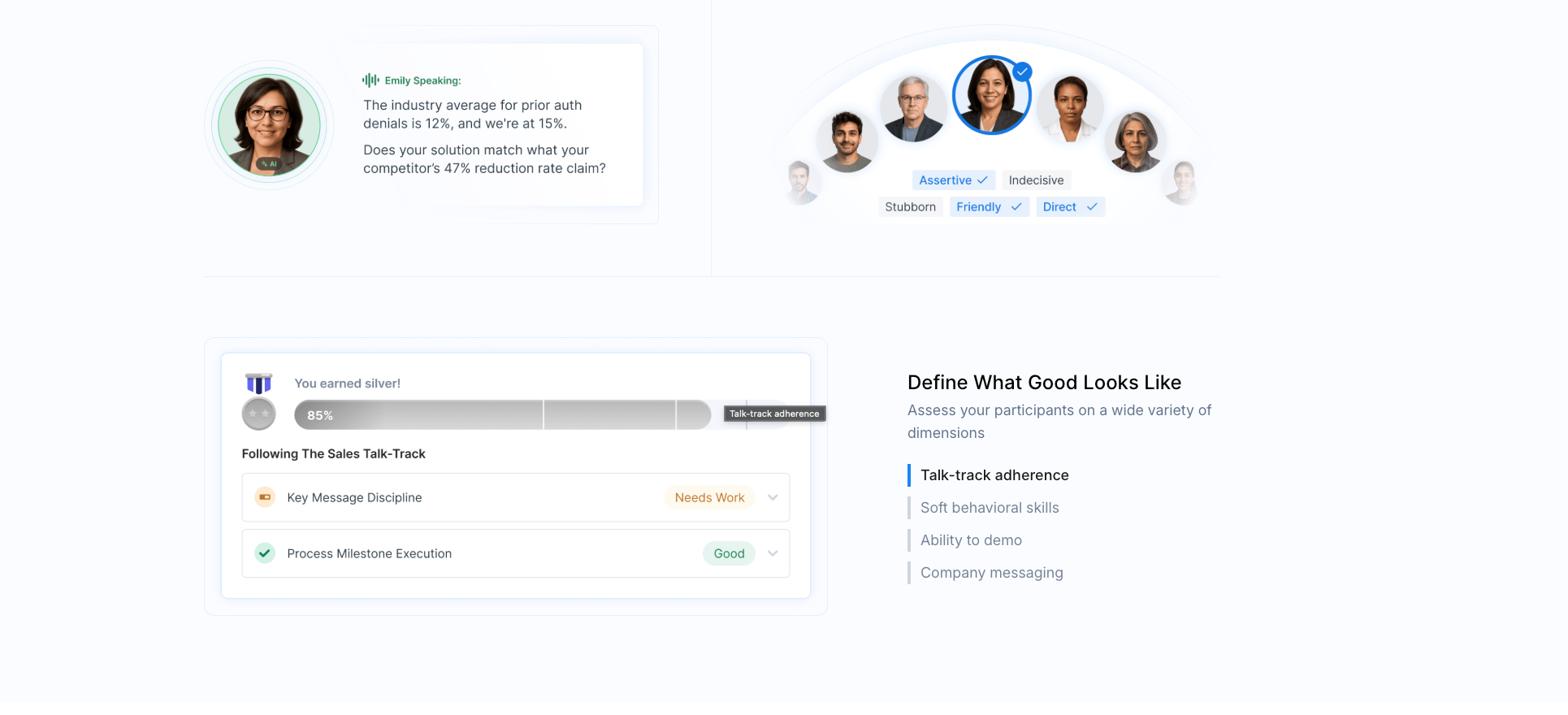
Bigtincan primarily anchors on sales and revenue enablement infrastructure, and Hyperbound focuses on SDR/AE outbound calls, so both cluster around narrower slices of the revenue lifecycle.
Choose the Platform That Turns Training Into Performance
Enablement leaders rarely struggle to buy more tools; they struggle to close the gap between all that infrastructure and how reps perform when the stakes are high.
Bigtincan is a strong fit if your biggest pain is content chaos and fragmented learning, and Hyperbound is compelling if the pipeline depends heavily on SDR cold calling that needs more realistic reps.
Exec becomes the better choice once you realize the main constraint is conversation readiness across the whole revenue journey, because it converts your actual plays, demos, and leadership moments into fast, scenario-specific practice that layers cleanly on top of systems you already own.
Ready to see how Exec transforms your existing content into conversation readiness? Book a demo.