
Bigtincan vs Outdoo AI: Which Platform Addresses Your Real Constraint?

Your reps just completed discovery call training. Two days later, a prospect asks about ROI, and they fumble through generic responses instead of uncovering real business pain. You've built the content library, refined the methodology, and invested in the training. So why does the same conversation keep failing?
Bigtincan addresses this by centralizing content, learning paths, and practice modules so reps can access the right materials and complete structured training. Outdoo AI tackles it by turning CRM data and actual call recordings into AI Buyer Twins that let reps practice against realistic scenarios tied to active deals.
This comparison explores which approach fits your constraint: comprehensive enablement infrastructure or CRM-connected conversation practice.
Platform Comparison At A Glance
Bigtincan is a revenue enablement platform providing content management, sales readiness, buyer engagement, and AI-powered coaching in a single system. The platform offers AI-driven content recommendations, mobile-first microlearning, secure buyer workspaces, and RolePlay AI for conversation simulation.
Outdoo AI is a revenue intelligence platform that combines AI-powered roleplay training, coaching analytics, and conversation intelligence to improve sales readiness. The platform works with existing conversation intelligence investments rather than replacing comprehensive enablement platforms.
Decision Criteria
Choose Bigtincan if:
You have distributed sales teams struggling with brand inconsistency and content access across regions
You have field reps lacking consistent connectivity and requiring offline content access during client visits
You manage content, training, and buyer engagement across 3+ disconnected tools
You accept longer implementation timelines for enterprise-scale capabilities
You prefer single-platform integration for AI roleplay, content, and training over managing separate tools
Choose Outdoo AI if:
You have existing Gong, Chorus, or Clari investments
You have Gong/Chorus call libraries, but lack systematic translation into practice scenarios
You need rapid deployment over extended implementation cycles
You prefer Outdoo AI's integration-first architecture over platform consolidation
You accept Outdoo AI's focus on conversation training while maintaining content management and buyer engagement on separate tools
Choose Exec if:
You need AI roleplay scenarios that can be customized quickly
You conduct product demos requiring screen-sharing practice with simultaneous visual and verbal evaluation during the same session
You need practice scenarios created in 90 seconds from recorded calls and marketing materials, without waiting for accumulated conversation intelligence data
You prioritize voice-based stress response learning that creates realistic customer unpredictability and pushback
You need conversation practice that extends across Sales, Customer Success, and Management roles with role-based scenario customization and custom rubric alignment
Bigtincan vs Outdoo AI vs Exec: Sales Enablement Platform Feature Comparison
Feature | Exec | Bigtincan | Outdoo AI |
G2 Score | |||
Scenario Creation | 90-second agentic creation | Manager-configured scenarios | Auto-generated from CRM pipeline data (not from recorded calls) |
Voice Practice | Voice-based with AI | Voice-enabled RolePlay AI | Voice-based AI roleplay |
Screen Sharing | Voice + screen evaluation | Not supported | Not supported |
Deployment Speed | Enterprise-grade with startup speed | Enterprise implementation | 1-month average |
Best For | Rapid custom scenario practice | Revenue enablement infrastructure | CRM-connected intelligence practice |
Starting Price | Custom enterprise quote
| Custom enterprise quote
| Custom enterprise quote |
Bigtincan Review
Bigtincan is a revenue enablement platform that combines content management, sales readiness, buyer engagement, and analytics into a unified system.
The platform serves customer-facing teams across sales, marketing, customer success, and channel partners. Organizations deploy Bigtincan to solve content chaos, inconsistent training delivery, and visibility gaps.
For sales enablement leaders, Bigtincan serves as a foundational revenue technology that addresses content governance challenges and scalable training needs.
The platform extends beyond sales-specific functionality to support cross-functional enablement, enabling marketing and customer success to have unified access to content.
Key Features
Content Management System
Centralized repositories with AI-powered recommendations based on deal context. The system handles version control and brand compliance enforcement across distributed teams.
Mobile-First Learning Delivery
Training accessible from any device with offline capability for field teams. Delivers adaptive microlearning through bite-sized modules and scenario-based learning. Reps complete training during downtime without requiring desktop access.
Buyer Engagement Workspaces
Secure, trackable workspaces where sellers, technical specialists, partners, and customers collaborate. Provides content sharing and collaboration tools in controlled environments.
RolePlay AI Simulation
AI-simulated buyer scenarios configured by managers for conversation practice. Provides AI-generated responses, feedback based on conversation performance, and scenario-based learning aligned with sales methodologies. Functions as a standalone capability within the enablement platform.
Pros
Mobile-first design with offline access for field sales teams lacking consistent connectivity
Content management, maintaining brand consistency with enterprise-scale personalization
Unified infrastructure consolidating content, training, buyer engagement, and analytics
Integration ecosystem connecting with existing CRM systems and built-in learning management capabilities
Cons
Reporting capabilities lack user-friendly interfaces despite data collection, though vendor customer success teams can help mitigate limitations
Upload issues and content management challenges impact administrator workflows during content deployment
Administrative interface customization requires engaging third parties to modify dashboard and homescreen configurations
Implementation timelines are not publicly disclosed, creating uncertainty for organizations prioritizing rapid deployment timelines
Outdoo AI Review
Outdoo AI is a revenue intelligence platform that combines AI-powered roleplay training, coaching analytics, and conversation intelligence.
Organizations deploy Outdoo AI when existing Gong, Chorus, or Clari investments capture customer conversations, but translating those conversations into structured practice remains manual or disconnected.
Outdoo AI auto-generates practice scenarios from CRM pipeline data and recorded customer calls. Outdoo creates call-tied roleplay from existing conversations without requiring manual scenario development.
The platform provides AI roleplay assessments, coaching intelligence that shows performance gaps, call scoring, and performance reports.
Key Features
CRM-Connected Scenario Generation
Auto-generates AI roleplay scenarios from actual CRM pipeline data. Creates practice environments reflecting real deals rather than generic templates.
Call-Tied Roleplay Creation
Creates practice scenarios directly from customer conversations recorded in Gong, Chorus, and Clari. Analyzes conversation patterns, identifies coaching opportunities, and generates corresponding roleplay environments.
Integration Architecture
Connects with Salesforce, HubSpot, Gong, Chorus, Clari, major LMS platforms, and communication tools through native integrations. Enables organizations to add conversation practice without replacing foundational systems.
Coaching Intelligence Dashboard
Provides data on performance gaps, skill development over time, and coaching effectiveness. Includes call scoring, performance reports, and skill development tracking for managers.
Pros
Rapid deployment enables fast implementation for organizations prioritizing speed over extended timelines
Integration-first architecture leveraging existing Gong, Chorus, Clari, and CRM investments without replacement
Automated scenario generation from real calls, eliminating manual creation time for practice environments
CRM and conversation intelligence integrations providing practice scenarios connected to actual pipeline data and customer conversation patterns
Cons
No screen-sharing capability during AI roleplay limits preparation for demo-heavy conversations
Scenario creation relies on existing call data rather than rapid custom creation for emerging situations
Platform effectiveness depends on organizations having a conversation intelligence infrastructure and existing call libraries to populate scenarios
How Exec Delivers What Bigtincan and Outdoo AI Cannot
Bigtincan provides a broad enablement infrastructure requiring learning design cycles. Outdoo AI builds practice from CRM and call data, requiring integration and call history. Exec converts talk tracks into practice in 90 seconds without those dependencies.
90-Second Agentic Scenario Creation
Exec spins up custom scenarios from plain-language prompts in about 90 seconds for same-day deployment when pricing or competitors shift. Bigtincan hosts RolePlayAI within courses that require broader rollout cycles.

Outdoo builds AI Buyer Twins from CRM, calls, and battlecards, producing realistic practice but needing data integrations and sufficient call history first.
Screen Sharing for Demos
Exec lets reps share screens, run live demos, and get feedback on both narrative and navigation.

Bigtincan offers video pitch certification focused on content usage rather than real-time demo navigation. Outdoo centers on call intelligence and voice roleplay, not screen-aware demo practice.
Voice-Based Stress-Response Learning
Exec builds simulations of interruptions, objection spikes, and topic shifts, sharpening decision-making under CFO or renewal-conversation pressure.
Bigtincan's video certification supports message consistency through structured assignments. Outdoo ties skills to revenue outcomes through real conversation analysis rather than explicit stress inoculation.
Revenue-Wide Scope and Custom Rubrics
Exec covers prospecting, demos, renewals, escalations, and manager conversations with custom rubrics for sales and leadership methodologies.
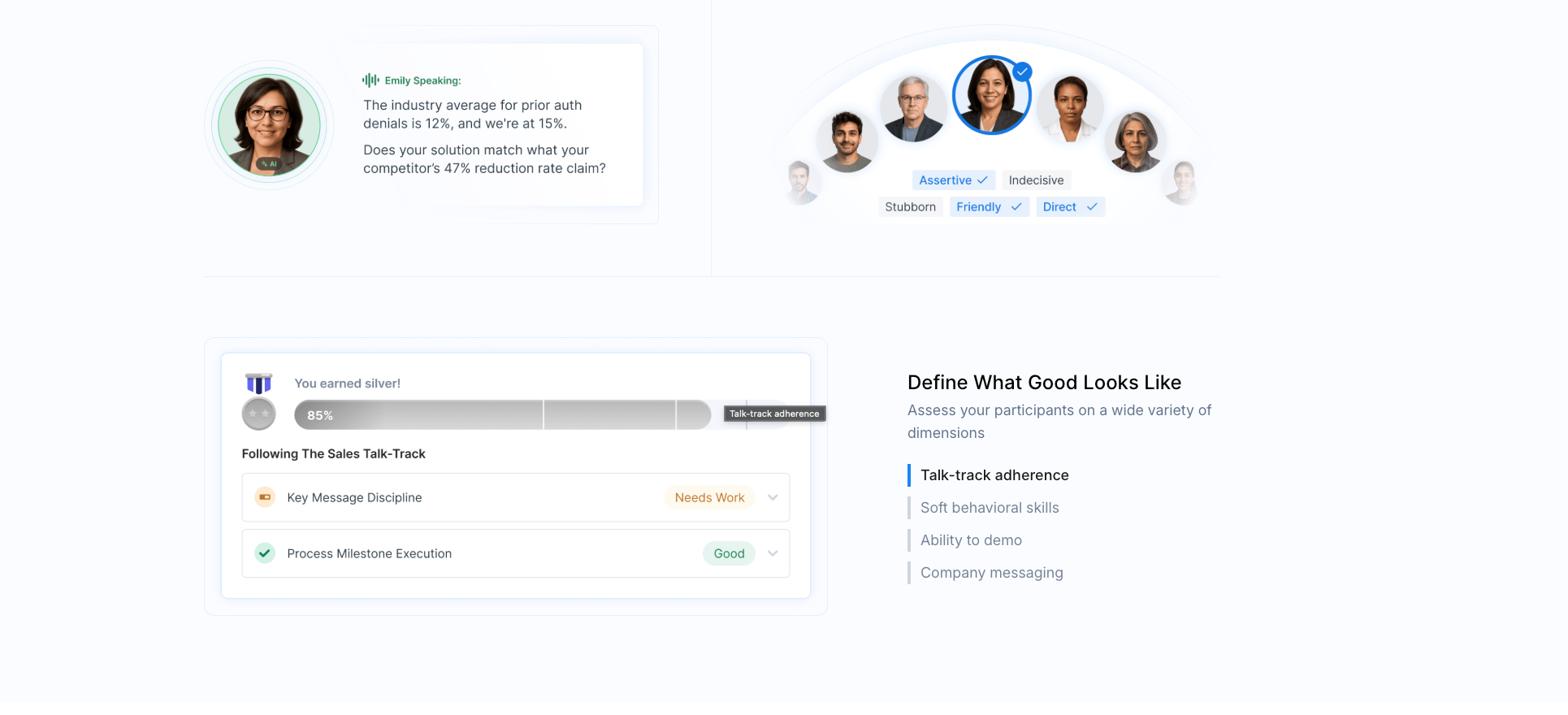
Bigtincan anchors on sales collateral and readiness across field teams. Outdoo focuses on AE and manager deal coaching rather than leadership or non-deal conversations.
Choose Speed When Revenue Timelines Won't Wait
Bigtincan works when scattered content and fragmented training need a single infrastructure layer. Outdoo AI works when call recordings and CRM data need conversion into deal-specific insights and coaching tied to pipeline health.
Exec works when you have content systems and call intelligence, but reps still underperform in high-stakes conversations.
It's a practice engine sitting on top of your stack, focusing on conversation readiness across the revenue journey without replacing what you own. Ready to layer practice on your existing systems? Book a demo.