
Exec vs Hyperbound: Which AI Roleplay Platform Fits Your Sales Team?

Your sales team completed MEDDIC training last quarter, achieved perfect test scores, and delivered flawless qualification recitations. Then a prospect mentions competitor demos, and your rep freezes. Instead of exploring decision criteria, they jump straight to feature comparison.
This happens because methodology knowledge doesn't become conversation competency without practice under pressure. AI roleplay platforms create that pressure safely, letting reps build skills before facing real prospects.
Exec and Hyperbound both use AI to accelerate skill development, but serve different scopes. Exec delivers enterprise-wide conversation practice across the entire sales cycle. Hyperbound focuses on voice-based cold calling for SDR teams.
This comparison helps sales enablement leaders choose based on organizational scope and training needs.
Exec vs Hyperbound At A Glance
Understanding platform scope matters before diving into feature details.
Brief Platform Overviews
Exec serves enterprise organizations that need rapid, custom scenario deployment across full revenue lifecycles. The platform creates tailored practice environments in minutes using agentic AI, enables screen-shared demo practice, and builds conversation competency across sales, customer success, and management roles.
Hyperbound targets SDR and AE teams with a voice-based cold calling simulation. The bot builder transforms ICP descriptions into AI buyers for outbound prospecting practice, with deep CRM integrations that connect practice scenarios to actual sales data.
Decision Criteria
Choose Exec if:
Teams need conversation practice beyond cold calling across discovery, demos, and closing
Screen-shared presentation practice matters for complex B2B sales cycles
Product launches demand immediate custom scenario deployment matching business timelines
Enterprise-wide conversation competency spans multiple customer-facing roles and use cases
Choose Hyperbound if:
Small team or SMB requiring only sales skill development
SDR team focus makes specialized prospecting practice more valuable than broad coverage
Deep CRM workflow integration ranks as the top technical priority
Exec vs Hyperbound Feature Comparison
Feature | Exec | Hyperbound |
G2 Score | ||
Scenario Creation | ~90 seconds (agentic AI) | ~2 minutes (bot builder) |
Voice Practice | Full voice AI | Voice-based cold calling |
Screen Sharing | Yes - demo practice | No |
Scenario Breadth | Full sales cycle + CS + manager | Cold calling focused |
Custom Rubrics | Upload frameworks (MEDDIC, SPIN) | Standard scorecards |
CRM Integration | Sales | Deep Salesforce/HubSpot |
Best For | Enterprise-wide competency | SDR/outbound teams |
Starting Price | Custom enterprise quote | Per-seat pricing |
Exec: Best for Enterprise-Wide Conversation Competency
Platform Overview
Exec is the Agentic Learning Platform, built for sales enablement leaders who need conversation training across a complete revenue organization. Agents produce the training from your own playbooks, conduct it, and evaluate the people doing it across AI roleplay, courses, knowledge management, call scoring, programs, and coaching. Where a cold-calling point tool optimizes one use case, Exec covers competency from the first prospecting touch through renewal and expansion.
The platform solves the deployment timeline problem through agentic scenario creation. Sales enablement leaders facing urgent product launches create custom practice environments in minutes rather than waiting months for traditional content development. Teams practice competitive objections, pricing discussions, and multi-stakeholder navigation with AI that responds unpredictably like real prospects under pressure.
The core differentiator: screen sharing during roleplays enables demo presentation practice where AI simultaneously evaluates conversation quality and on-screen actions, building confidence for the complete customer interaction rather than separating talk tracks from visual presentation.
Platform Features
Agentic Scenario Creation
Agentic scenario creation uses AI to generate fully customized roleplay scenarios in approximately 90 seconds from simple text or voice prompts, incorporating your actual customer context, competitive intelligence, and product specifics.
Traditional training content development takes months. Sales enablement leaders need teams ready for competitive pricing objections before next week's product launch, not next quarter after the opportunity window closes.
How it works: A sales enablement leader opens Exec and types: "Create a discovery call where the prospect has seen our competitor's demo and pushes back that our solution costs 30% more with similar features." Minutes later, the scenario is live.
The rep joins the roleplay. The AI prospect answers.
AI Prospect: "Thanks for reaching out. I've been comparing your platform to [Competitor]. They quoted us $40, whereas your quote was $52K. Why should I pay 30% more for what looks like similar features?"
Rep: "I understand price is a concern. Let me ask, what specifically attracted you to their solution?"
AI Prospect: "Their workflow automation looked solid, and the price point works for our budget."
Rep: "That makes sense. Can you walk me through your current process so I understand where automation would help most?"
The conversation continues for six minutes. The rep addresses pricing but moves quickly to feature comparison without uncovering timeline or stakeholder details.
Session ends. AI scoring appears: "You acknowledged the price concern and asked good questions about their current process. However, you missed asking about their decision timeline, budget approval process, and other stakeholders involved. You justified ROI before understanding their complete buying situation."
The rep runs the scenario again. This time, before discussing price, they uncover that procurement needs three vendor quotes, the CFO makes the final decisions, and implementation must happen before Q4. The pricing conversation shifts from cost justification to strategic timing and stakeholder alignment.
After five practice sessions, the rep handles competitive pricing objections without hesitation. Launch day arrives. The team is ready for real conversations, not learning through lost deals.
Unlimited Voice-Based AI Roleplay Practice
On-demand voice conversations with AI prospects that respond unpredictably like real customers create the call pressure necessary for skill retention rather than scripted responses that build false confidence.
Reps practice discovery, objection handling, and closing without scheduling colleagues for roleplay sessions. This transforms practice from occasional training events requiring calendar coordination into a daily habit-building that creates muscle memory through repetition under pressure.
Screen Sharing During Roleplays
Reps present slides and demo products during voice conversations while AI simultaneously evaluates both conversation quality and presentation effectiveness, providing feedback on messaging clarity, visual flow, and how reps handle questions during demos.
Complex B2B sales depend on presentation quality as much as conversation skills. Separating talk-track practice from actual product demonstration creates artificial training environments that don't replicate real customer meetings, where questions interrupt slides and technical details require on-screen clarification.
A cybersecurity sales rep practices their discovery demo. They share their screen, pull up their standard slide deck, and begin presenting to the AI CISO. Three slides in, the AI interrupts: "Wait, go back to that architecture diagram. How does this integrate with our existing SIEM?"
The rep navigates back to the diagram, highlights the integration points, and explains the API connections. The session ends. AI feedback addresses both conversation elements and presentation mechanics: "You handled the technical interruption well by acknowledging the question immediately before navigating back. Consider bookmarking key technical slides for faster access during technical stakeholder presentations."
Custom Rubrics & Performance Scoring
Organizations upload sales methodology frameworks (MEDDIC, SPIN, Challenger, custom approaches) and AI scores every practice session against those specific standards, ensuring feedback aligns with how your organization defines conversation excellence.
Generic improvement suggestions, disconnected from your sales approach, create confusion. Reps receive feedback that contradicts their manager's coaching or doesn't align with your methodology priorities. Certification becomes meaningless when scoring doesn't reflect actual business standards.
A B2B SaaS company using MEDDIC to define exactly how they expect reps to qualify opportunities. Reps practice discovery calls. The AI scores against their actual MEDDIC standards: "You identified the economic buyer but didn't uncover decision criteria. You asked about the budget but missed exploring champion strength. Your discovery covered 4 of 6 MEDDIC components thoroughly."
Programs, Cohorts, and Certification
Programs sequence roleplays, courses, coaching sessions, and required milestones into structured learning paths, with assignment management, deadline tracking, certification workflows, and analytics that connect practice engagement to win rates and deal velocity.
Sales enablement leaders create programs, assign scenarios by role, and access analytics that show real-time engagement, average scores by scenario and region, common failure patterns across teams, and the correlation between practice volume and deal progression rates.
Exec Pros
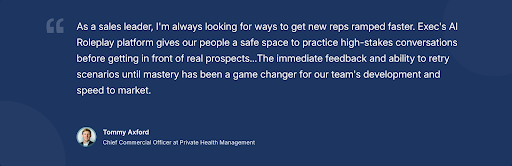
1. Rapid deployment matches business urgency
Custom scenarios deploy in minutes rather than traditional development cycles measured in months, matching product launch timelines and competitive threats that demand immediate conversational readiness.
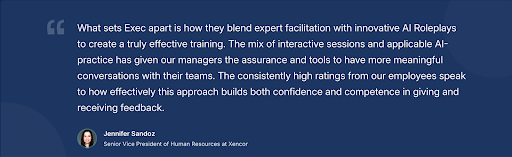
2. Voice-based realism creates measurable skill transfer
Stress-response learning through realistic pressure builds conversation competency that withstands actual customer interactions, not just product knowledge that evaporates when prospects push back unexpectedly.
3. Enterprise-wide coverage beyond prospecting
Manager feedback conversations, customer success renewals, complex multi-stakeholder sales cycles, and technical discovery all receive the same conversation practice infrastructure that SDR-focused platforms reserve exclusively for cold calling.
4. Screen sharing enables complete demo practice
Presentation practice includes AI feedback on both conversation elements and visual effectiveness, building confidence for the complete customer interaction rather than separating talk tracks from product demonstration reality.
Exec Cons
Not Built for Very Small Teams
Exec serves enterprise organizations needing conversation competency at scale across multiple teams and use cases. Companies requiring only 1-2 practice seats find a better fit with entry-level platforms designed for individual skill development rather than organizational transformation.
Requires Customization Investment
The platform excels at creating bespoke practice environments tailored to your specific business context, competitive situations, and sales methodologies. Organizations seeking completely pre-configured, generic scenarios without customization investment find that the flexibility requires more setup effort than off-the-shelf alternatives.
Hyperbound Review
Platform Overview
Hyperbound is a voice-based AI coaching platform explicitly designed for cold calling practice and SDR skill development. The platform optimizes its entire feature set around a single use case: helping outbound teams practice phone-based prospecting without risking real leads.
The bot builder converts ICP descriptions into AI buyers for cold-calling simulations. Deep CRM integrations pull actual sales data into practice scenarios, making it relevant for outbound-focused teams. Real-time feedback and consistent scoring mechanisms help managers focus coaching time on analysis rather than conducting repetitive roleplay sessions.
Customers highlight time-saving manager features, accelerated SDR onboarding, and realistic cold-calling practice that builds confidence before reps touch real prospects. Hyperbound supports over 25 languages, enabling multinational SDR teams to practice in their target markets.
For organizations where cold calling drives the business and SDR performance determines pipeline health, Hyperbound delivers focused, in-depth prospecting skill development.
Platform Features
AI Buyer Bot Builder: Converts ICP descriptions into AI buyers for cold-calling simulations, with customizable buyer personas that reflect specific objections, industry contexts, and personality traits that match target prospects. Some customers report that the initial setup requires more creativity and time investment than anticipated.
Real-Time Feedback & Scoring: Delivers AI-driven performance analysis after each call with analytics focused on cold calling effectiveness. The automated feedback reduces the time managers spend conducting role-play sessions.
Call Analytics & Reporting: Dashboards track individual rep improvement and team performance trends for cold calling activities, providing visibility into which reps complete practice, average performance scores, and common struggle patterns across SDR teams.
Objection Handling Practice: Enables reps to practice objection responses in voice environments before facing actual prospects, building confidence for handling prospecting resistance without risking real opportunities.
CRM & Sales Enablement Integrations: Integrates with Salesforce, HubSpot, and other CRM platforms to incorporate actual sales data into cold calling practice scenarios. The deep CRM integration represents Hyperbound's strongest technical capability.
Hyperbound Pros
1. High-volume cold calling practice without risking leads
Accelerates SDR skill development through unlimited phone-based prospecting practice before touching real prospects, eliminating the cost of learning through burned opportunities.
"Hyperbound is helping expedite the training and onboarding of SDRs with more realistic reps. We can conduct mock cold calls that are very realistic and give directional feedback through custom scorecards that we've created."
2. Manager time optimization through AI scoring
Consistent, unbiased feedback reduces manager roleplay time while maintaining coaching quality, allowing leaders to focus on performance analysis rather than conducting repetitive practice sessions.
"Hyperbound completely optimizes managers' time, allowing focus on call analysis and rep improvement instead of repetitive roleplays."
3. Deep CRM integration
Strong Salesforce and HubSpot connections pull actual sales data into practice scenarios, making outbound teams' cold calling simulations more relevant by incorporating real pipeline context.
Hyperbound Cons
1. Cold calling specialization limits broader applications
The platform optimizes exclusively for voice-based prospecting without extending to screen-shared demos, discovery calls requiring presentation, technical product demonstrations, manager effectiveness training, customer success conversations, or full sales cycle development. Organizations needing conversation practice beyond initial outbound prospecting require supplemental platforms for other customer-facing scenarios.
2. Initial setup requires time investment
Sales leaders report that creating effective bot personas demands more upfront creativity and configuration than anticipated, adding hidden implementation costs before teams achieve consistent practice value.
3. Quality depends on scenario design
The effectiveness relies heavily on well-crafted scenarios and input data quality. Organizations without clear ICP definitions or objection patterns struggle to create realistic practice environments that translate into actual cold-calling performance.
Which Platform Should You Choose?
The decision between Exec and Hyperbound depends on your conversation training scope and organizational complexity.
Hyperbound serves organizations where cold calling drives primary business value and SDR team specialization justifies focused investment.
The platform delivers depth in voice-based prospecting practice. The deep CRM integration creates relevance for teams whose pipeline health depends on consistent cold-calling execution.
Exec addresses organizations that require conversational competency across the full revenue lifecycle, from initial discovery through demo presentations to renewal discussions.
The rapid scenario deployment matches business urgency when product launches or competitive threats demand immediate readiness. Screen sharing enables demo practice that matters for complex B2B sales where presentation quality determines outcomes.
The enterprise learning platform coordinates conversation training across distributed teams and multiple customer-facing roles.
Key decision factors:
Conversation Scope: If cold calling represents your complete training need, Hyperbound's specialization delivers focused value. If teams need practice across discovery, demos, objection handling, closing, and customer success, Exec's breadth addresses the full scope.
Demo Requirements: If your sales process depends on screen-sharing presentations where both conversation quality and visual effectiveness determine outcomes, Exec's screen-sharing capability addresses that reality. If phone-based prospecting drives your business without demo requirements, Hyperbound's voice-only format suffices.
Organizational Scale: If you're managing 5-20 SDRs with focused cold calling needs, Hyperbound works well. If you're coordinating conversation competency across 100+ customer-facing professionals in multiple roles, Exec's enterprise platform provides the necessary coordination infrastructure.
Scale Conversation Excellence Across Your Organization
Hyperbound excels at developing cold-calling skills for SDR teams. Exec delivers enterprise-wide conversation competency throughout the entire sales cycle.
The choice depends on the scope. Organizations needing only prospecting practice find value in Hyperbound's specialization. Teams requiring conversation readiness across demos, discovery, and customer success need Exec's AI sales roleplay simulator.
Ready to see how Exec builds conversation competency that withstands customer pressure? Book a demo.