
PitchMonster vs Hyperbound: Which AI Sales Roleplay Tool Is Best for Your Team?

Your SDR team needs to practice cold calls before Monday's outbound push. Your AEs need to tighten their demo talk tracks before a Thursday presentation. Same week, different practice problems.
Choosing between PitchMonster and Hyperbound comes down to what "practice" means for your team.
PitchMonster focuses on sharpening conversation quality: tightening talk tracks, cleaning up filler words, and running reps through 48 ready-to-use scenario-based roleplays.
Hyperbound leans into volume and realism for outbound, simulating cold calls and discovery with AI buyer bots built from your ICPs in under 2 minutes.
This piece breaks down how each platform works, where they shine, and what to consider if your practice needs extend beyond a single use case.
PitchMonster vs Hyperbound At A Glance
PitchMonster is an AI-powered sales roleplay practice platform designed for general sales teams at accessible midmarket price points. The platform supports practice for product demos and presentations, with AI evaluating the quality of the spoken pitch and how reps structure and deliver their message.
Hyperbound is a cloud-based AI sales coaching platform specializing in SDR conversation practice and cold calling. Built on analysis of thousands of B2B sales calls, the platform converts ICP descriptions into interactive AI buyers in under 2 minutes.
Choose PitchMonster if
You want a focused AI roleplay tool to improve core sales conversations, such as cold calls, discovery, and objection handling.
You value simple, prompt‑driven scenario setup, along with a library of prebuilt roleplays and scorecards.
You care a lot about detailed language feedback (filler words, clichés, clarity) to sharpen talk tracks.
You’re looking for a lightweight, easy‑to-understand tool rather than a broad enablement suite.
Choose Hyperbound if
Your main priority is improving outbound performance: cold calls, gatekeeper conversations, discovery calls, and early‑stage calls.
You want AI buyer bots built from your ICP descriptions so SDRs and AEs can repeatedly drill specific personas and objections.
You like the idea of a simulated dialer and high‑volume call blocks for realistic, call‑center‑style practice.
You already track call performance and want analytics on objection handling and call outcomes to guide coaching.
Choose Exec if
You need new, custom practice scenarios in minutes when pricing, product, or competitor dynamics change, not after long content builds.
Demo and presentation quality are critical, and you want live screen‑sharing practice with AI feedback on both what reps say and what they show.
You want one practice engine that covers sales, customer success, and leadership conversations, not just outbound calls.
You prefer a platform that works well on its own and is easy to pilot with a small group before scaling.
PitchMonster vs Hyperbound vs Exec Feature Comparison
Item | Exec | PitchMonster | Hyperbound |
G2 Score | |||
Starting Price | Custom enterprise | Not publicly listed (tool directories only) | Custom; sales-led (no public list) |
Screen Shared Demo Practice | Yes | No | No |
Scenario Creation Speed | Very fast; prompt to scenario in minutes | Fast, prompt-based plus prebuilt templates | Fast; buyer bots from ICPs in minutes |
Voice-Based Roleplay | Yes | Yes | Yes |
Custom Rubric / Scorecard | Yes, supports custom scoring criteria | Yes, custom scorecards per scenario | Yes, custom scoring on call outcomes |
Best For | Demo + conversation practice across sales, CS, leadership | Tightening talk tracks for core sales calls | High-volume outbound and early-stage call practice |
Integration Capabilities | Works standalone; optional LMS/CRM | Light; mainly web app, limited public integration details | Integrates with sales stack (CRM, dialer, analytics) |
PitchMonster Review
Platform Overview
PitchMonster is an AI sales roleplay platform designed to help reps practice and refine their talk tracks before speaking with real buyers.
It offers a library of ready‑made sales scenarios, such as cold outreach, discovery, and objection handling, as well as the ability to create custom roleplays with your own prompts and scorecards.
Reps get instant feedback on structure, clarity, pacing, and overused phrases, making it easier to tighten messaging over time.
Teams can assign scenarios, review scores, and track improvement without needing a heavy, all‑in‑one enablement system.
Platform Features
Prebuilt Scenarios
Ready-to-use scenarios covering demonstrations, discovery, and objection handling enable immediate practice without waiting for custom scenario creation. Teams start practicing the same day rather than building content first.
Adaptive AI Personas
AI personas adapt during practice sessions based on how reps approach conversations. The system evaluates conversation effectiveness and adjusts responses to create realistic buyer interactions.
Custom Coaching Standards
Organizations upload coaching standards to customize AI evaluation criteria. Performance feedback aligns with specific methodologies rather than generic conversation quality metrics.
Presentation Practice
Reps upload presentations and practice delivery while receiving feedback on verbal pitch quality. This addresses sales cycles that require coordinated verbal and presentation skills.
Pros
Easy to understand and use for reps and managers.
Good library of ready-made scenarios for common sales situations.
Focus on tightening language and delivery in calls.
Fast to roll out without a big implementation project.
Cons
Focuses mainly on calls, not demos or non-sales conversations.
Limited coverage for later-stage or customer success interactions.
Needs sales enablement leaders to design the broader training program around it.
Hyperbound Review
Platform Overview
Hyperbound is an AI sales coaching platform focused on call practice for outbound and early‑stage selling.
It converts your ICP descriptions into AI buyer bots, then lets reps run simulated cold calls, discovery, and follow‑ups in an environment that feels like a live calling block.
A dialer‑style interface and objection libraries push reps to handle real-world resistance before they hit the phones.
Managers get analytics on call quality, objection handling, and team progress, helping them target coaching where it will have the most significant impact.
Platform Features
Rapid Scenario Creation
Converts ICP descriptions into interactive AI buyers in under 2 minutes. Teams respond to competitive threats or product launches without traditional content creation wait times.
Voice-Based Cold Calling Practice
AI buyers present industry-specific objections and buying committee dynamics. Reps prepare for real-world outbound sales motions through realistic cold calling simulations.
Custom Scorecards
Analyzes performance against any sales methodology, providing immediate feedback on conversation effectiveness without requiring manager time for every practice session.
Call Analysis Integration
Examines representatives' actual sales calls to identify areas of struggle. Recommends personalized scenarios based on individual skill gaps to improve closed-loop practice.
Pros
Good for practicing cold calls and early discovery.
AI buyer bots make practice feel close to real prospects.
Simulated call blocks help reps build stamina and confidence.
Analytics help managers see who struggles with which objections.
Cons
Narrow focus on outbound and early-stage calls.
Not designed for demo practice or leadership and CS conversations.
Value depends on having clear ICPs and call workflows already defined.
How Exec Delivers What PitchMonster and Hyperbound Cannot
PitchMonster and Hyperbound all use AI roleplay to help sales teams practice. PitchMonster sharpens what reps say in common sales scenarios.
Here's where Exec goes beyond what either platform provides.
Covers demos and multi‑function conversations, not just calls
Exec supports a wide range of high‑stakes conversations: sales calls, product demos, renewal and escalation meetings, QBRs, and even internal leadership updates.
Where PitchMonster and Hyperbound excel at call‑centric practice, Exec also helps SEs, AEs, CS, and managers rehearse the complex demos and leadership conversations that decide large deals and customer retention.
This breadth makes Exec worthwhile as a shared practice layer for multiple functions, not only SDRs and AEs.
Enables demo-grade screen‑sharing practice
Exec allows reps and SEs to share their screen during AI roleplays, run full product demos or slide decks, and receive feedback on both the spoken narrative and their navigation of the interface or presentation.

That matters when deals hinge on explaining complex workflows, handling technical questions mid‑demo, and adjusting the story in real time. PitchMonster and Hyperbound focus on voice-only simulations, so they do not fully address the unique demands of demo and presentation practice.
Delivers rapid, ad‑hoc scenarios without heavy setup
With Exec, a manager can describe a new objection, pricing change, or competitive story in plain language and have a usable practice scenario ready within minutes. This speed enables frontline leaders to keep training aligned with what is actually happening in the field.

PitchMonster and Hyperbound both support custom scenarios, but they are primarily designed around fixed playbooks and recurring call patterns, which makes fast, one‑off scenario deployment less central to their use.
Serves the whole revenue lifecycle, not just outbound readiness
Exec is built to support conversation quality across the entire customer journey, from first touch and qualification to implementation, renewal, and expansion, plus internal performance feedback and coaching conversations.
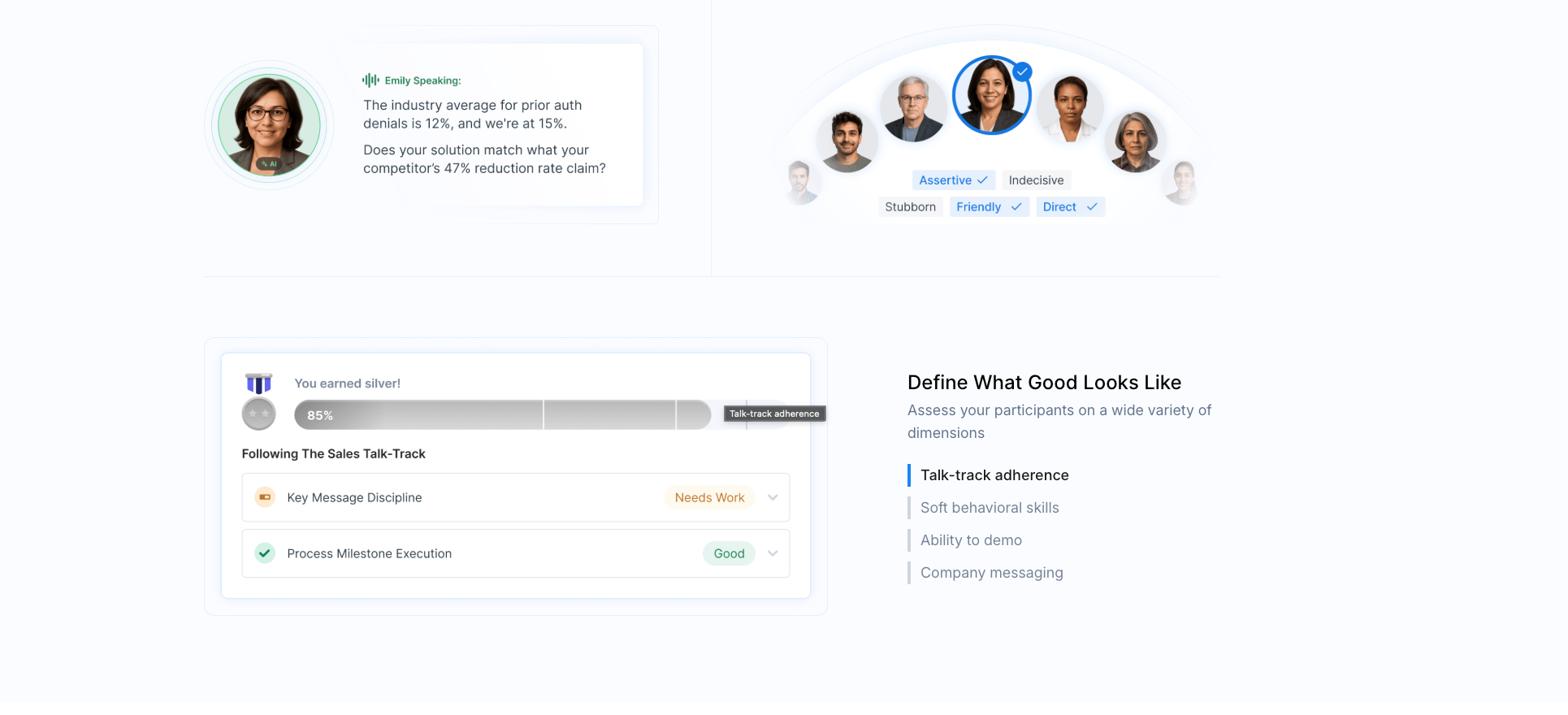
PitchMonster and Hyperbound are strongest in outbound and early‑stage sales motions. By extending practice into later‑stage and post‑sale interactions, Exec helps organizations close the gap between training and performance across all conversations that impact revenue, not just the first calls.
Choose the Platform That Matches Business Urgency
PitchMonster and Hyperbound each shine in specific parts of the sales process: one in sharpening talk tracks, the other in high‑volume outbound call practice.
Exec takes a broader view. It adds fast scenario creation, demo‑grade screen‑sharing, and realistic voice practice across sales, success, and leadership, giving teams one place to rehearse the conversations that actually move deals and keep customers.
For leaders who want readiness measured in real interactions rather than isolated call drills, Exec is a strong fit. To see how it could work with your team, book a demo.