
Product
Multilingual Scenario Studio: build and run roleplays in eight more languages
May 19, 2026 · The Exec Team
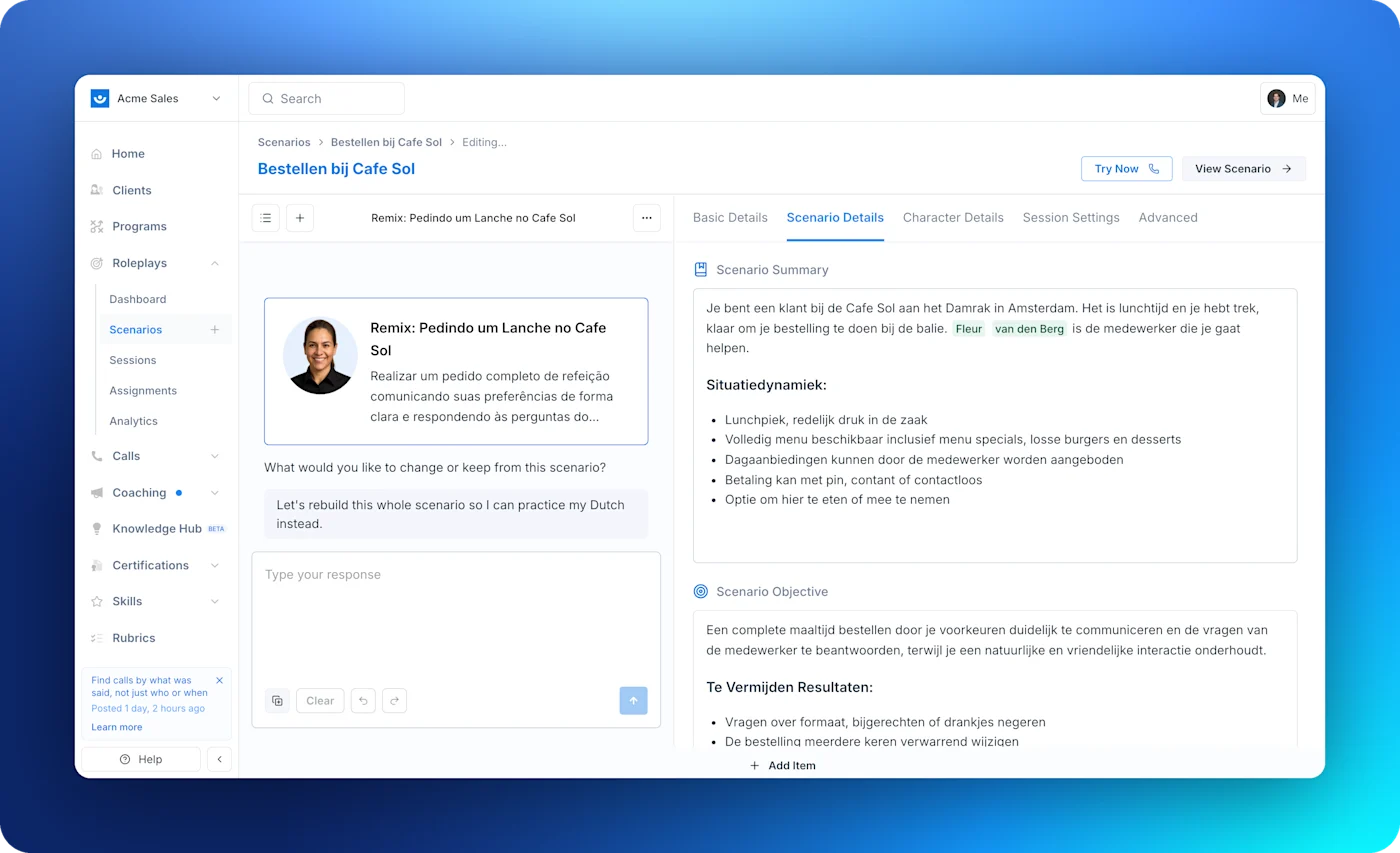
Scenario Studio now generates and runs roleplays in eight languages beyond English: Spanish, French, German, Portuguese, Dutch, Japanese, Chinese, and Korean. For global sales and enablement teams whose reps sell in those languages, this means the simulated character speaks, listens, and responds directly in whatever language you choose. The intro audio, character voice, and AI Coach debrief all run in the target language.
Each language has its own curated voice library, selected for accent and quality. You preview a voice before assigning it to a character, same as in English.
Global sales teams have been asking us for this since the early days. Reps who sell in Tokyo or Madrid or São Paulo were practicing their discovery and objection handling in English, then walking into live calls in Japanese or Spanish or Portuguese. The skills transfer, sure. But the specific phrasing, the pacing, the way you read a skeptical buyer's tone in that language, that only comes from practicing in it.
There are three ways to build a multilingual scenario.
The first is to build natively. You prompt the Scenario Agent in the target language, write the character description, the context, the evaluation criteria in that language, and the agent generates the entire scenario in it from scratch. The character's opening line, the conversation guidelines, the scorecard feedback, everything comes out in the language you wrote in.
The second is to take an existing English scenario and switch it. Open session settings, change the language, and rewrite the character and context into the target language. This is the fastest path when you already have a proven scenario and just need a version of it for a different region.
The third is to remix and mass-translate. Remix a scenario, set the language in session settings, and Scenario Studio translates everything at once: the character profile, the conversation guidelines, the evaluation criteria, the intro audio. You get a complete copy in the new language that you can then adjust and refine.
Every scenario still gets its own custom scorecard. The criteria you defined for the English version carry over, and you can edit them in the target language or rebuild them from scratch. A discovery scenario in German can grade the same things the English version graded, or different things entirely, depending on what your team in that region needs to measure.
And the character is still open-ended. A Japanese buyer can be friendly and curious or guarded and dismissive. A Spanish procurement officer can be rushed, skeptical, enthusiastic. The personality, mood, and behavior you give the character in Scenario Studio are whatever the scenario calls for, in whatever language it runs in.
Companies like Infosys and ServiceNow already train global teams on Exec. With multilingual Scenario Studio, those teams can now build practice environments in the languages their reps actually sell in. Multilingual Scenario Studio gives teams native practice conversations for the markets where they sell, conversations that sound and behave the way buyers in those markets do.
Open Scenario Studio and pick a language. The whole build flow works in it.