
Bigtincan vs PitchMonster: Sales Enablement Platform Comparison

Bigtincan built its reputation on mobile-first content management for enterprise field sales teams. PitchMonster carved out space with accessible AI roleplay practice and ready-to-deploy scenarios.
Both platforms address conversation readiness, but through different mechanisms. Bigtincan embeds practice within a comprehensive enablement infrastructure. PitchMonster strips away content management to focus purely on AI-powered roleplay.
The question for sales enablement leaders: Does your team need enterprise content governance with practice included, or specialized conversation training without the platform complexity?
Bigtincan vs PitchMonster At A Glance
Understanding core positioning helps narrow evaluation criteria before examining specific capabilities.
Brief Platform Overviews
Bigtincan is an enterprise sales enablement platform. It combines content management, practice modules, and AI conversation practice. Built for enterprise sales teams needing mobile content access and centralized control.
PitchMonster is an AI roleplay practice platform. Built for mid-market and growth companies needing conversation practice. Uses AI avatars with configurable buyer personas for sales simulation. Provides automated performance analysis, including filler word detection.
Decision Criteria
Choose Bigtincan if:
Field sales needs mobile content access during customer meetings across 200+ users
Centralized content governance addresses scattered materials problems
Procurement requires enterprise security certifications and formal vendor evaluation
Three-month implementation timelines fit your deployment schedule
Choose PitchMonster if:
Your team needs conversation practice running this week, not this quarter
Simplified interfaces matter more than comprehensive enablement features
Mid-market pricing around $15/user/month fits budget constraints
Prebuilt scenarios cover immediate practice requirements without custom development
Choose Exec if:
Competitive threats require the same-day practice deployment
Complex B2B presentations need a combined conversation and demo evaluation
Conversation competency spans sales, customer success, and manager roles
Your team can't wait weeks for implementation cycles
Bigtincan vs PitchMonster vs Exec Feature Comparison
Feature | Exec | Bigtincan | PitchMonster |
G2 Score | |||
Scenario Creation | 90-second agentic generation | Template-based content creation | 48 pre-built plus custom |
Voice Practice | Unpredictable AI with stress-response pressure | Text and audio conversations | AI avatar roleplay |
Screen Sharing | Demo practice with AI evaluation | Not available | Presentation upload |
Deployment Speed | Same-day scenarios | Three-month implementation | Immediate for pre-built |
Best For | Revenue-wide conversation readiness | Enterprise content governance | Specialized sales roleplay |
Starting Price | Custom enterprise pricing | Approximately $29–$50/user/month | Approximately $15/user/month |
Bigtincan Review
Platform Overview
Bigtincan is an enterprise sales enablement platform built mobile-first for field sales organizations. The platform consolidates content management, practice modules, and AI conversation capabilities under centralized administrative control.
Enterprise teams choose Bigtincan when scattered content across systems leads to customer meeting failures, when version-control problems result in outdated pricing discussions, and when field sales need access to materials without desktop workstations.
The platform addresses these challenges through automatic version control and mobile-first distribution.
Platform Features
Content Management and Distribution
Organizes, distributes, and recommends sales collateral with analytics showing how buyers engage with materials. Sellers access content from within Salesforce and other CRM tools, with activity auto-logged to deal records.
Training and Learning Modules
Video-based roleplays, quizzes, and adaptive learning paths tied to roles and skill levels. Managers assess skills, compare outcomes across reps, and guide improvements through coaching dashboards.
SalesAI Content Recommendations
AI-driven content suggestions based on CRM data, interaction history, and seller behavior. Recommends relevant materials as deals progress, rather than requiring manual searches.
Enterprise Deployment Support
Multi-language content support, mobile access for field sellers, and white-glove onboarding with migration support from legacy enablement tools. SDK, APIs, and custom widgets are available for complex enterprise workflows.
Pros
Reduces vendor complexity for teams currently managing separate content, training, and coaching tools.
CRM integration connects content and training usage with pipeline activity and deal outcomes for ROI visibility.
Advanced customization through SDK, APIs, and custom widgets supports complex enterprise workflows.
Migration support reduces switching friction for teams moving from legacy enablement tools.
Cons
Platform breadth feels heavy for teams that primarily need focused roleplay or lightweight coaching, without the complete enablement infrastructure.
Implementation and configuration require significant admin effort, which may not suit smaller or fast-moving teams.
Roleplay exists as one feature among many rather than a specialized capability with rapid iteration.
Pricing and positioning target mid-market and enterprise, which exceeds what early-stage or smaller sales teams require.
PitchMonster Review
Platform Overview
PitchMonster is an AI roleplay practice platform for sales teams that need focused conversation practice without broader enablement infrastructure.
The platform provides AI-powered simulations for cold calls, discovery meetings, product demos, and presentations.
Teams choose PitchMonster when they need fast deployment of roleplay scenarios, automated feedback on conversation quality, and consistent coaching without scheduling live practice sessions.
PitchMonster targets organizations prioritizing specialized practice over comprehensive enablement suites.
Platform Features
AI Roleplay Simulations
Customizable buyer personas and scenarios tailored to your ICPs, objections, and typical sales conversations. Covers cold calls, discovery meetings, product demos, and presentations with AI responding based on configured buyer behavior.
Automated Conversation Feedback
Highlights strengths and gaps in objection handling, question quality, and call flow after each session. Breaks down specific moments in the conversation rather than providing only summary scores.
AI Speech Coaching
Analyzes pacing, sentence structure, filler words, and overused phrases. Functions as ongoing language coaching that identifies verbal patterns that reps may not notice themselves.
Custom Scorecards
Upload existing evaluation criteria or use prebuilt scorecard libraries for consistent, automated scoring aligned to your sales methodology.
Prebuilt Scenario Library
Ready-made roleplay scenarios for objection handling, discovery, and pitching that teams can assign immediately without custom development.
Pros
Purpose-built for AI sales roleplay rather than embedding practice as one feature within a broader platform.
Feedback depth breaks down language patterns, filler words, and sales clichés in practical, coach-like detail.
Fast deployment using prebuilt scenarios with option to layer in custom prompts and personas as teams mature.
Scalable coaching without scheduling live roleplays for managers who need consistent practice across distributed teams.
Cons
Requires pairing with other tools for a full enablement stack.
Limited public documentation on enterprise integrations. Operational fit with existing CRM and LMS may require validation during proof of concept.
Less emphasis on linking roleplay performance directly to pipeline and win-rate analytics compared to full revenue enablement platforms.
Enablement leaders must design the surrounding curriculum, reinforcement, and certification processes themselves rather than using the built-in program structure.
How Exec Addresses What Both Platforms Miss
Bigtincan embeds roleplay within a broader enablement suite where practice competes with content management and LMS administration. PitchMonster focuses on sales call practice with prebuilt scenarios and language feedback.
Neither solves the speed problem when competitive situations demand custom practice.
90-Second Scenario Creation
Exec generates custom AI scenarios from plain-language prompts in approximately 90 seconds. Bigtincan scenarios require configuration within broader programs over the course of weeks. PitchMonster relies on prebuilt scenarios plus manual setup.

A sales enablement director learns that three deals are at risk due to a competitor's pricing move. She opens Exec: "Create a scenario where the prospect received a 20% lower quote and is questioning our premium."
Ninety seconds later, the scenario deploys. The AE practices, gets feedback on where she accepted the prospect's framing without probing workflow requirements, and reruns it. By the fourth session, she's prepared for Thursday's conversation.
Screen-Shared Demo Practice
Exec supports live screen sharing during role plays, so reps receive AI feedback on both conversation quality and presentation delivery. Neither Bigtincan nor PitchMonster provides screen-sharing evaluation for demo practice.
Product demos require navigating slides while handling interruptions. Practicing talk tracks separately from actual demos creates artificial training.
Revenue-Wide Scope
Exec serves account executives, sales engineers, customer success, and managers. Bigtincan is a broad enablement hub where roleplay is one feature among many. PitchMonster focuses narrowly on sales call roleplay.
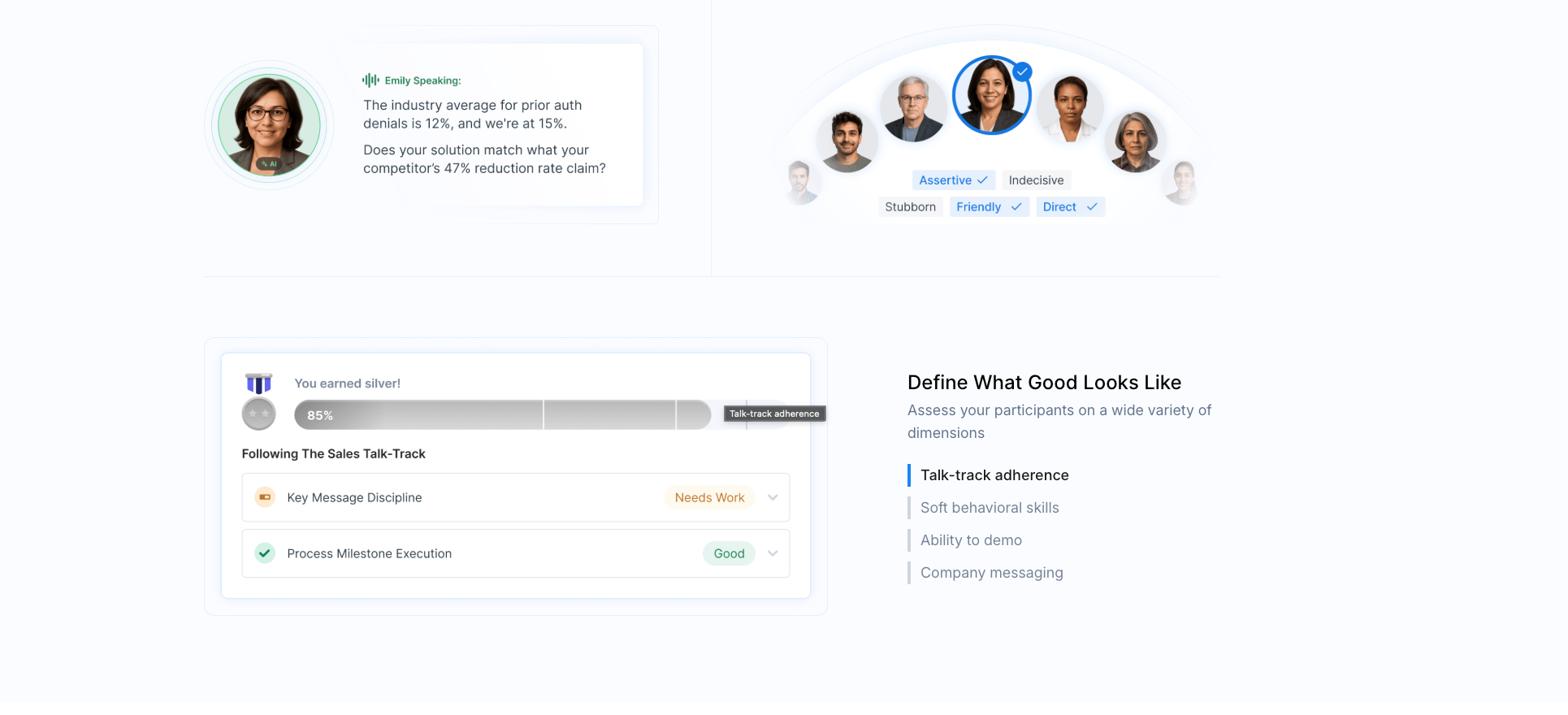
Customer success needs renewal readiness. Managers need a feedback conversation capability. Conversation gaps affect multiple revenue-critical interactions beyond initial sales calls.
Choose Conversation Readiness Over Training Completion
The right choice depends on what's actually broken in your training today.
Are your reps having trouble finding the right content during customer meetings? Bigtincan's enterprise infrastructure handles content governance at scale.
Your team needs roleplay practice without wrestling with a complex platform? PitchMonster's prebuilt scenarios get them practicing this week.
However, speed is a different problem. When a competitor drops pricing and your team has calls tomorrow, when your reps need demo practice that evaluates what's on screen, Exec addresses what neither platform provides.
Ready to see custom scenarios deploy in 90 seconds? Book a demo.