
Allego vs Outdoo AI: Which Sales Enablement Platform Closes the Learning-Doing Gap?

Your rep struggled with a pricing objection on Tuesday's call. Outdoo AI would convert that call into a practice scenario so others can rehearse it. Luster AI would have flagged that rep's pricing confidence gap last week, before the customer conversation happened.
Two different approaches to the same problem: closing the gap between practice and performance.
Luster AI positions itself as a Predictive Enablement platform, using analytics to identify performance gaps before they affect the pipeline.
Outdoo AI operates as a revenue intelligence platform, converting actual recorded sales calls into practice scenarios grounded in real customer objections.
This comparison evaluates how each platform works in practice so revenue and enablement leaders can decide which better fits their training strategy and tech stack.
Luster AI vs Outdoo AI At A Glance
Platform Architectures
Luster AI operates as a Predictive Enablement platform combining AI-powered practice simulations with predictive analytics to identify performance gaps before they impact revenue. The platform serves mid-market to enterprise B2B SaaS companies focused on proactive gap prevention rather than reactive analysis.
Outdoo AI evolved from MeetRecord into a comprehensive revenue intelligence platform, with AI roleplay as one component, supporting multiple languages and integrations for mid-market B2B SaaS companies with 50-500 employees.
Decision Criteria
Choose Luster AI if:
You prioritize predictive performance gap prevention over reactive analysis
You need screen-sharing practice for demo-heavy sales processes
You focus exclusively on go-to-market teams rather than customer success scenarios
You prefer proactive intervention before customer conversations
Choose Outdoo AI if:
You want to turn real sales calls and CRM data into AI “buyer twins” that reps can practice against for discovery calls, pricing, and negotiation.
You prioritize call-centric practice and coaching tightly tied to actual deals, pipeline metrics, and revenue intelligence.
You need flexible AI roleplay agents created either from prompts or recordings, then embedded into structured training courses and programs.
Choose Exec if:
You need custom practice scenarios created in minutes for new messaging, pricing, or product launches, without heavy instructional design.
High‑stakes demos, presentations, and leadership conversations matter as much as calls, and you want one platform for sales, success, and internal communication.
You care about voice-based simulations that mimic real pressure, with analytics that connect practice patterns to win rates and revenue outcomes.
Luster AI vs Outdoo AI vs Exec Feature Comparison
Attribute | Exec | Luster AI | Outdoo AI |
G2 rating | |||
Best for | Broad roleplays: sales, leadership, CS. | Sales practice tied to CRM and pipeline. | Sales coaching plus revenue intelligence. |
Screen sharing | Yes, supports screen‑share roleplays. | Yes | No |
Voice practice | Yes, voice‑based roleplays. | Yes. | Yes |
Scenario creation | Agentic, under 90 seconds | Scenarios by stage, persona, and deal size. | Fast AI roleplay agents and custom scenarios. |
Starting price | Custom enterprise pricing | Custom enterprise pricing | Custom enterprise pricing |
Luster AI: Review
Luster AI is a predictive enablement platform that helps go‑to‑market teams identify and close skill gaps before they impact revenue. It combines hyper‑realistic AI roleplay, targeted skill drills, and gamified learning paths with rich analytics at the rep and team level.
By analyzing performance data and real call insights, Luster diagnoses where sellers struggle, predicts future gaps, and automatically prescribes practice and coaching.
Managers get scalable, AI‑generated coaching and clear ROI visibility, while reps get personalized, engaging practice that improves performance.
Platform Features
Predictive Insights
Real-time intelligence monitoring performance strengths and gaps with weekly insights and individual coaching plans. The system analyzes practice patterns and CRM data to identify which representatives face the highest risk of underperformance, enabling proactive intervention with contextual practice suggestions.
AI-Powered Roleplay Scenarios
Unlimited on-demand practice with AI avatars trained specifically for each customer's sales environment. The proprietary generative AI discourse engine creates simulations tailored to your buyer personas, competitive landscape, and objection patterns.
Multi-Stakeholder Scenario Support
Practice scenarios involving multiple buyer personas for complex enterprise sales. Teams rehearse navigating different stakeholder priorities and objection patterns within single practice sessions.
Pros
Helps spot skill gaps early and suggests what each rep should practice next.
Gives detailed analytics so leaders can see what is working and who needs help.
Makes practice more engaging with realistic simulations and structured paths.
Cons
It can feel complex to set up and tune because of its predictive and data-heavy focus.
Best value comes when you already have good call and CRM data feeding it.
May feel more like a “program” tool than something for quick, ad‑hoc practice.
Go-to-market team focus leaves customer success retention conversations unaddressed
Outdoo AI: Review
Outdoo AI operates as a comprehensive revenue intelligence platform, with AI roleplay practice as one component within a broader suite that converts actual recorded sales calls into AI practice scenarios.
The architecture ties coaching to active pipeline opportunities, grounding practice in actual business outcomes.
Sales and revenue enablement teams can embed roleplay agents into courses, scale coaching with automated feedback, and prove training impact with revenue intelligence.
Platform Features
Scenario Import from Real Calls
Converts recorded Gong or Chorus calls into custom AI roleplay scenarios with reusable personas and goals applicable across any sales cycle stage. Your conversation intelligence archives become a practice library reflecting actual customer behavior patterns.
Multi-Modal Practice Environment
Chat, video, and voice-based roleplay with team selling modes, analyzing both verbal and non-verbal cues. The platform accommodates different practice modalities and conversation contexts.
Multi-Language Support
Practice environments in 70+ languages serving multinational sales organizations. Global capability enables enterprise sales teams to operate across geographic markets without requiring separate platform instances.
Revenue Intelligence Integration
240+ real-time signals tracking deal health, momentum, and risk from conversations, engagement, and buyer behavior. Practice connects to broader pipeline analytics and CRM automation.
Pros
Converting real sales calls into practice scenarios grounds work in actual customer behavior patterns specific to your market
Deal-based architecture connects practice directly to pipeline opportunities, enabling measurement from practice to actual revenue outcomes
Flexible agents from prompts or recordings, plus courses built around those agents.
Cons
Focuses mainly on sales calls, so less suited for demos or non-sales conversations.
Works best when you already record calls and have clean CRM data.
The options for agents, courses, and analytics can be a lot for smaller teams at first.
How Exec Delivers What Luster AI and Outdoo AI Cannot
Both platforms share critical limitations that prevent comprehensive conversation practice programs across revenue organizations. Here’s how Exec addresses those limitations:
Built For High-Stakes Demos And Exec Conversations
Exec goes beyond call practice to support demos, product walkthroughs, and executive‑level presentations where what is on screen and how it is framed matters as much as the talk track.
Teams can present decks or live product flows to interactive AI audiences that ask tough questions and objections, then receive targeted feedback on clarity, sequencing, and narrative.
Luster and Outdoo focus primarily on sales conversations and predictive coaching, but are less specialized for demo excellence and internal leadership communication.
Scenario Creation That Matches GTM Speed
Exec’s agentic scenario creator allows leaders to deploy new, tailored practice environments in minutes, aligned to product launches, pricing changes, or competitive shifts, without long content‑build cycles.
That makes it easier to keep practice in lockstep with the reality of deals this week, not last quarter. Luster and Outdoo offer powerful simulations based on data and calls, but their emphasis on predictive models and call libraries can add complexity when you simply need fast, just‑in‑time scenarios.
Voice Pressure For Real-World Readiness
Execs lean into voice‑based simulations that deliberately trigger light stress, helping reps and leaders build confidence, pace, and adaptability under pressure before facing customers or executives. This focus on stress‑realistic practice closes the gap between “knowing the playbook” and actually responding effectively in live challenges.

Luster and Outdoo provide rich AI practice environments and analytics, but their core value centers more on predictive coaching and call‑driven roleplays than on intentionally engineered pressure training across roles.
One Platform For Sales, Cs, And Leadership Training
Exec is designed as a single practice engine for sales, customer success, support, and leadership, covering renewal conversations, escalations, QBRs, and internal performance management.
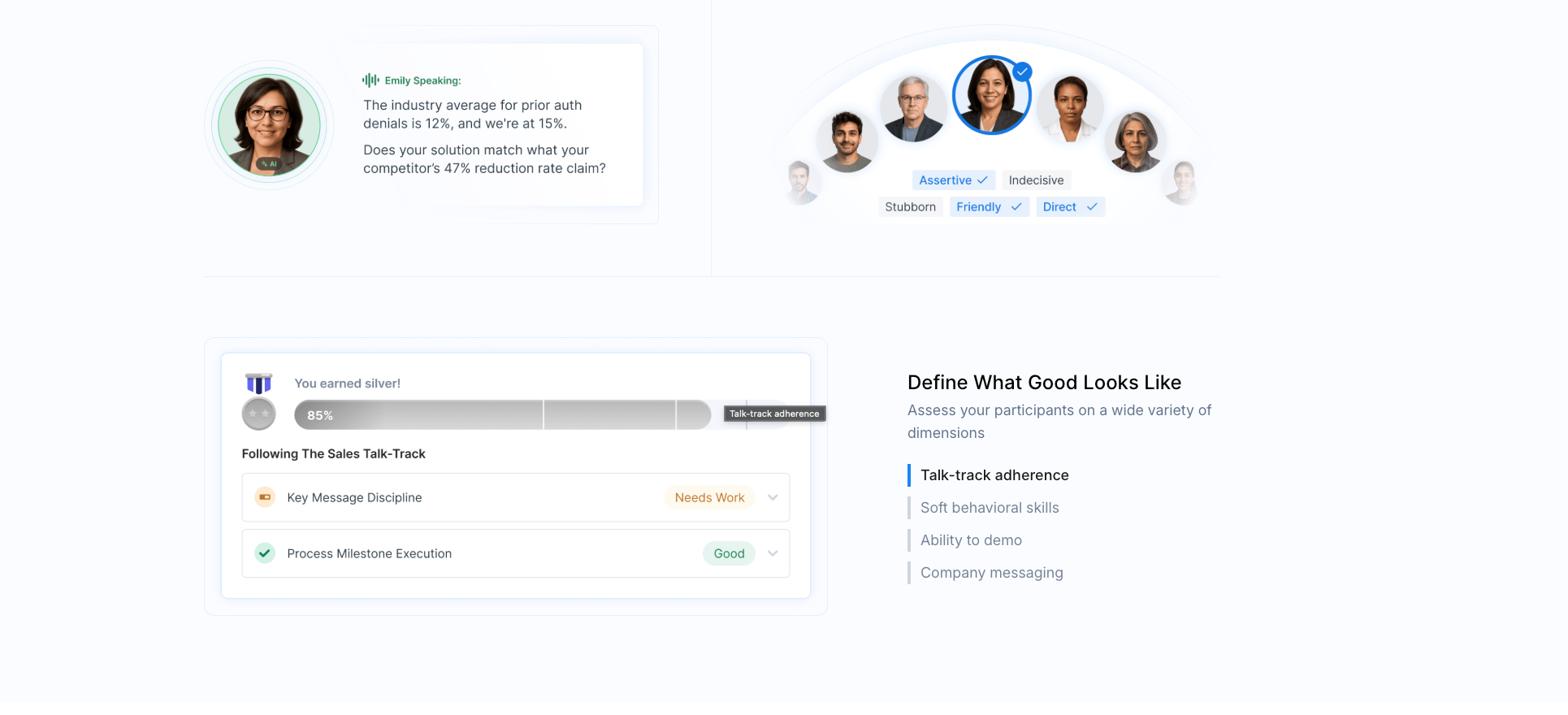
Organizations can integrate AI roleplays into broader training programs, automate assignments by role, and track readiness across multiple functions, not only revenue calls. Luster and Outdoo primarily focus on sales and GTM motions, which can limit their reach into cross‑functional communication and internal leadership skill-building.
Choose the Platform That Matches Your Conversation Readiness Timeline
Luster AI and Outdoo AI both offer strong, data‑driven practice environments, one centered on predictive enablement, the other on call‑linked buyer twins and coaching.
Exec complements these ideas with something broader: fast scenario creation, demo‑grade simulations, and voice‑based practice that prepares people for the actual pressure of high‑stakes conversations across sales, success, and leadership.
For teams that judge enablement by live performance rather than course completion, Exec provides a practical, flexible path forward.
To explore how this could work for your sales team, book a demo.